Answer Brief
Use the NIST AI Risk Management Framework to build an AI security watchlist tailored to East Asia cyber and AI risk monitoring. Map signals to governance owners, define evidence thresholds, and separate research digests from operational signals using flexible, source-grounded steps.
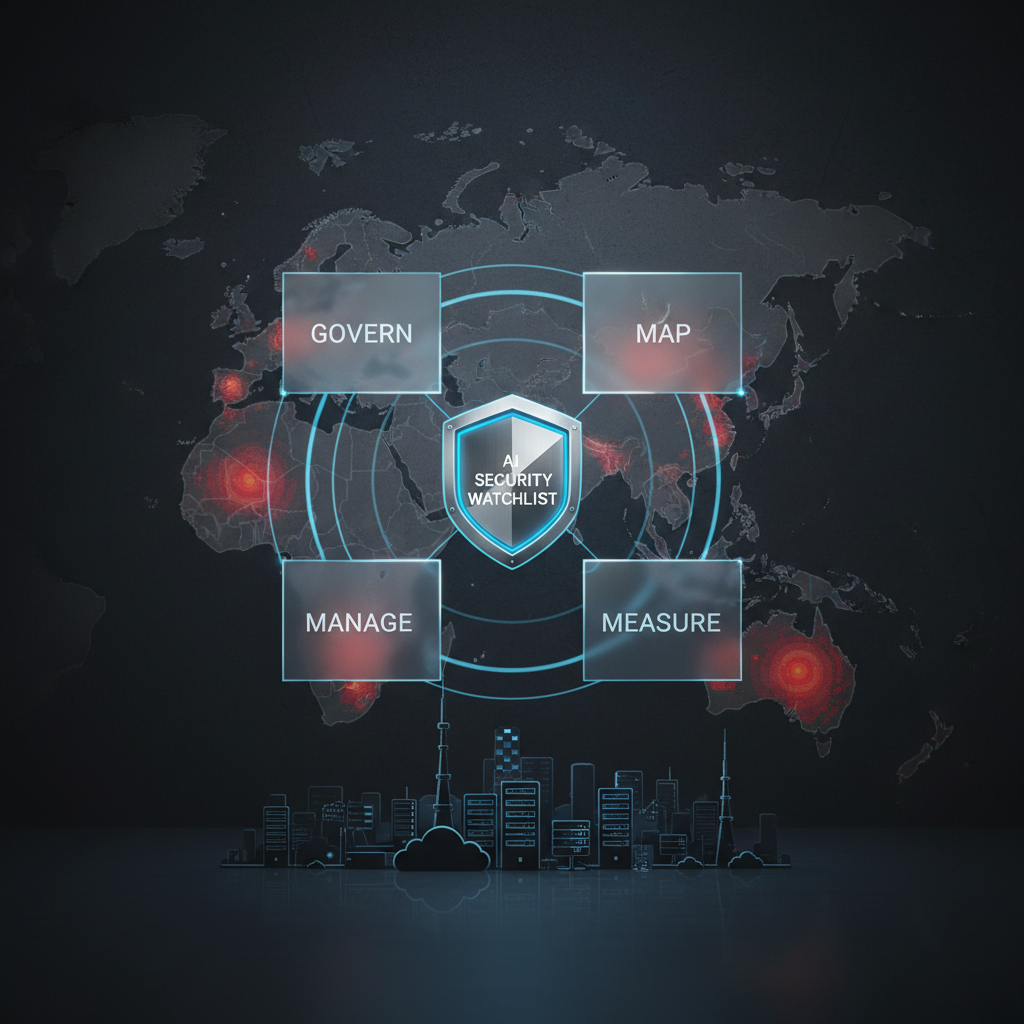
Executive Summary: Use the NIST AI Risk Management Framework to build an AI security watchlist tailored to East Asia cyber and AI risk monitoring. Map signals to governance owners, define evidence thresholds, and separate research digests from operational signals using flexible, source-grounded steps.
Why It Matters
The NIST AI Risk Management Framework (AI RMF) provides a structured, voluntary approach to managing AI-related risks that can be adapted by East Asia-facing security, AI, and cloud teams to build a practical AI security watchlist. Rather than treating the watchlist as a passive list of threats, teams should use the AI RMF’s four core functions—Govern, Map, Measure, Manage—as organizing principles to assign ownership, define workflows, and set decision criteria. This approach ensures that signals from East Asia sources are not only collected but also acted upon in a coordinated, risk-based manner.
In the Govern function, establish clear roles and responsibilities for AI risk oversight. Assign governance owners—such as chief information security officers, AI ethics leads, or risk management committees—to define the watchlist’s scope, approve inclusion criteria, and ensure alignment with organizational policies and regional regulatory expectations in markets like Japan, Singapore, or Taiwan. This function should also include periodic review of whether the watchlist remains focused on first-hand, region-specific signals rather than generic global noise.
Technical Signal
The Map function involves categorizing observed AI-related signals from East Asia sources—such as vulnerability disclosures from JPCERT/CC, AI misuse reports from KISA, or cloud configuration alerts from CSA—according to the AI RMF’s taxonomy. Teams should map each signal to specific AI lifecycle stages (design, development, deployment, use) and risk categories (e.g., bias, security, privacy, safety). This step helps avoid duplication and ensures that signals are contextualized within the organization’s AI asset inventory and use cases.
For Measurement, define evidence thresholds that determine when a signal warrants inclusion in the watchlist. These thresholds should be based on source credibility, technical specificity, and regional relevance—for example, requiring a CERT advisory, a confirmed exploit, or a detailed technical report from a reputable East Asia source. Avoid including signals based solely on media reports, unverified social media claims, or academic papers without observed exploitation. Measurement also involves tracking changes over time, such as increases in reported AI-driven phishing or model poisoning attempts in the region.
Operational Impact
In the Manage function, prioritize signals based on potential impact and likelihood, then assign remediation or mitigation owners. Escalation should be considered when a signal indicates active exploitation of AI systems in critical infrastructure sectors like energy, telecom, or finance in East Asia, or when it reveals a TTP that could affect regional supply chains. Use flexible language such as 'consider escalating' or 'recommend further review' rather than hard rules, and always require verification before triggering incident response.
Finally, maintain a strict separation between operational signals and research digests. Research papers, even those studying AI risks in East Asia, should be tracked separately and not included in the active watchlist unless they are accompanied by observed incidents, exploit code, or tactical guidance seen in the wild. This separation prevents alert fatigue and ensures that the watchlist remains focused on actionable intelligence for security, cloud, and operations teams.
What To Watch
Treat the official source as a monitoring input, not as proof that every feed entry deserves a public article. The practical value is a repeatable triage layer: capture the source title, original URL, visible publication date, affected product or service when available, and the operational surface involved. When those fields are thin or ambiguous, the item should stay in the tracker as monitoring data rather than becoming a standalone post.
For readers watching East Asia, the escalation question is whether the notice touches a real local, national, regional, sector, or operating dependency. Supplier exposure, cloud identity, telecom, financial services, government systems, semiconductor or manufacturing links, public-sector technology, managed service providers, and internet-facing infrastructure are strong signals even before global media frames them as cross-border events.
A healthy workflow separates three outcomes. Routine items become searchable tracker records. Items with clear patch urgency, exploitation language, named affected technology, or cross-border supplier relevance become article candidates. Items that are old, duplicated, underspecified, or mostly vendor boilerplate should remain monitor-only even if they contain familiar cybersecurity keywords.
The useful reader task is comparison. Analysts should ask whether the same vendor, CVE family, attack surface, sector, or region appears across multiple sources. A single notice can be weak by itself, while a cluster across CERT, vendor, and security research sources can justify a higher-priority brief. Nogosee should preserve that distinction so the site behaves like an intelligence tracker instead of a rewrite feed.
Event Type: security
Importance: medium
Affected Sectors
- AI development
- cloud operations
- critical infrastructure
- governance
Frequently Asked Questions
How should East Asia-facing teams use the NIST AI RMF to structure an AI security watchlist?
Map observed AI-related signals from East Asia sources to the AI RMF’s core functions—Govern, Map, Measure, Manage—and assign clear ownership for each function. Use the framework to categorize signals by risk type and prioritize based on potential impact to critical infrastructure or AI systems in the region.
What evidence thresholds should guide inclusion of AI security signals in an East Asia-focused watchlist?
Include signals only when they are first-hand, region-specific, and supported by verifiable sources such as CERT advisories, government announcements, or reputable research. Avoid speculation; require clear technical or operational detail before adding a signal to the watchlist.
How should research digests be handled differently from operational AI security signals in the watchlist?
Keep research digests on a separate daily budget and do not treat them as active threats. Use them for trend awareness and future monitoring, but do not escalate or act on them unless they are corroborated by observed incidents or technical evidence in the East Asia context.
Who should own governance, mapping, measurement, and management functions in an AI security watchlist workflow?
Assign clear owners: governance to policy or risk teams, mapping to threat intelligence or security operations, measurement to analytics or SOC teams, and management to incident response or IT operations. Ensure cross-functional coordination and documented handoffs.
What are flexible escalation thresholds for AI security signals in an East Asia-facing watchlist?
Escalate when a signal shows active exploitation, confirmed impact on critical infrastructure, or clear TTPs targeting AI systems in the region. Use cautious language like 'consider escalating' or 'review for further context' instead of rigid rules, and always verify with multiple sources before acting.