Answer Brief
Organizations can transform Korea KISA/KrCERT vulnerability notices into an auditable internal patch-SLA workflow by establishing clear triage steps, ownership rules, severity interpretation, exception tracking, and integration with existing vulnerability management systems—without imposing rigid thresholds or inventing unsupported procedures.
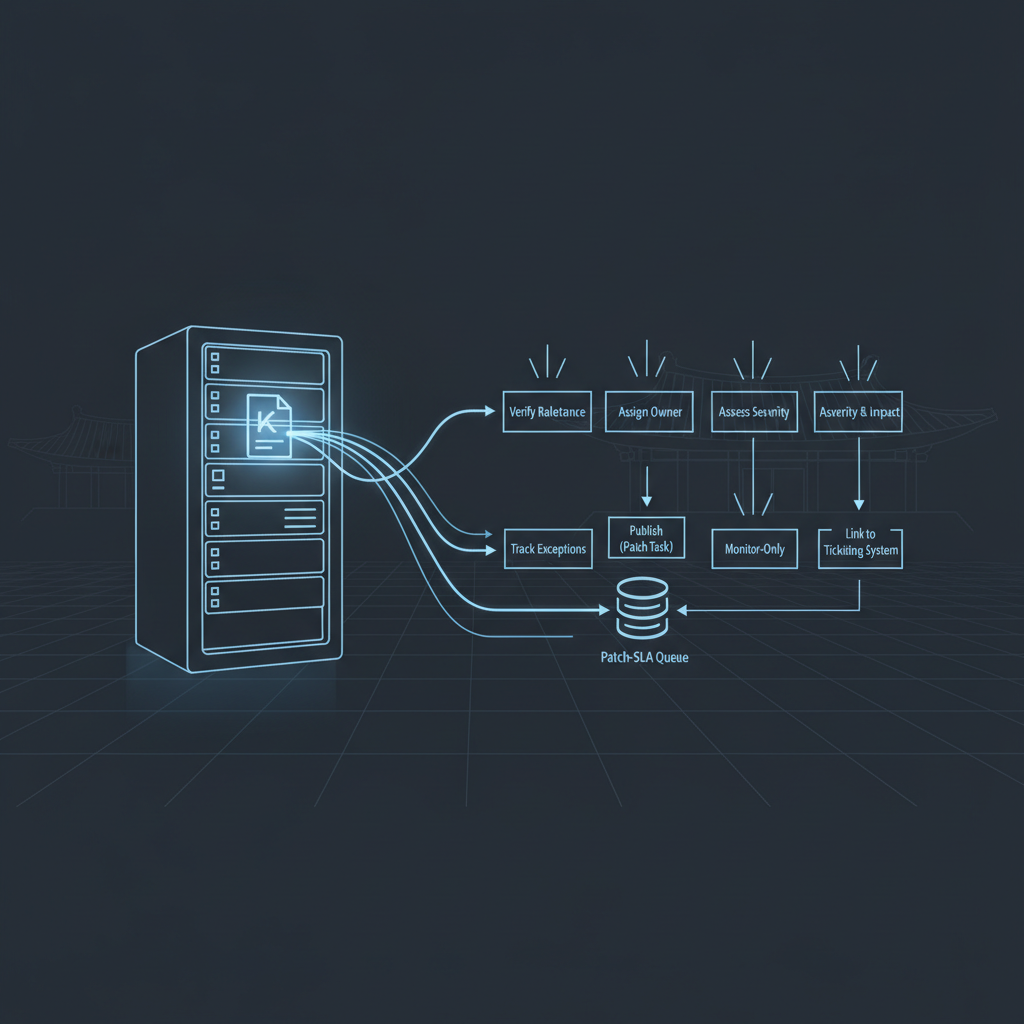
Executive Summary: Organizations can transform Korea KISA/KrCERT vulnerability notices into an auditable internal patch-SLA workflow by establishing clear triage steps, ownership rules, severity interpretation, exception tracking, and integration with existing vulnerability management systems—without imposing rigid thresholds or inventing unsupported procedures.
Why It Matters
The Korea Internet & Security Agency (KISA) and Korea Computer Emergency Response Team (KrCERT) vulnerability feed serves as a regionally specific early-warning system for software and systems prevalent in South Korea’s digital infrastructure. Unlike global vulnerability databases that may lag in reflecting locally exploited flaws or region-specific software variants, KISA/KrCERT notices often include details on vulnerabilities actively targeted in Korean networks, patches for domestically developed software, and advisories tied to local threat actor activity. This makes the feed a high-value signal for organizations with operational ties to Korea’s technology ecosystem, particularly those managing systems that run Korean-language software, serve Korean user bases, or interconnect with Korean network providers.
Turning these notices into an internal patch-SLA queue requires a disciplined triage process that begins with verifying environmental relevance. Teams must not assume applicability; instead, they should cross-reference each notice against their asset inventory to confirm whether the affected software, version, or configuration exists in their environment. This step prevents alert fatigue and ensures resources are focused on genuine exposure. Relevance determination should be documented, even when negative, to maintain an auditable trail of decision-making.
Technical Signal
Ownership assignment should follow pre-established responsibility mappings rather than ad hoc judgments. The default owner is the team or individual accountable for maintaining the affected system’s patching lifecycle, as recorded in configuration management databases (CMDB), service ownership maps, or IT asset management tools. When ownership is unclear—such as in cases of shared infrastructure, legacy systems, or third-party managed services—the item should be routed to a designated vulnerability management coordinator for resolution using available ownership metadata. This approach avoids assigning responsibility based solely on job title or organizational hierarchy and instead ties accountability to demonstrable control over the asset.
Severity assessment must combine the technical score provided in the notice (e.g., CVSS) with organizational context. A high CVSS score on an isolated development system may not warrant urgent action, while a medium-severity flaw on a public-facing web application handling customer data could require prioritization. Teams should define internal severity tiers that weigh exploitability, asset criticality, exposure level, and compensating controls—such as network segmentation, web application firewalls, or endpoint detection—but avoid fixed numeric thresholds. Instead, use flexible language like ‘consider escalating when the vulnerability could impact customer data confidentiality or service availability’ to allow for situational judgment.
Operational Impact
The decision between ‘publish’ (actionable patch task) and ‘monitor-only’ status hinges on exploitability, prevalence in the wild, and internal exposure. Publish when the notice confirms active exploitation, references a proof-of-concept, or describes a flaw affecting internet-facing assets without mitigations. Use monitor-only for vulnerabilities requiring local access, affecting isolated test environments, or impacting systems with strong monitoring and segmentation where immediate patching poses operational risk. This determination should be revisable; a monitor-only item may be upgraded to publish status if new threat intelligence emerges or environmental changes increase exposure.
Exception tracking is critical for maintaining workflow integrity. When patching cannot proceed within the desired timeframe, teams should log the notice with a clear justification—such as dependency on a third-party vendor patch, need for functional testing, or operational constraints during peak periods—alongside interim mitigations (e.g., firewall rules, access restrictions, enhanced monitoring) and a defined review date. Exceptions must not become permanent exemptions; they should be treated as temporary deferments subject to re-evaluation when conditions change, such as after a maintenance cycle, upon resolution of a blocking dependency, or when new indicators of threat appear.
What To Watch
Integration with existing vulnerability management processes ensures the workflow remains sustainable. Each internal item derived from a KISA/KrCERT notice should link back to the original source via URL and publication date, preserving auditability. These items should feed into ticketing systems, risk registers, or patch management tools, enabling traceability from initial notice to remediation confirmation. Over time, this creates a repeatable triage layer that leverages regional early-warning signals without overclaiming their scope or inventing rigid procedures unsupported by the source.
For organizations monitoring South Korea’s threat landscape, the operational value of KISA/KrCERT notices extends beyond technical details. Notices touching on sectors such as finance, government, telecommunications, semiconductors, manufacturing, or internet-facing infrastructure—especially when they name specific local software products, cloud services used in Korea, or supply-chain dependencies—warrant closer scrutiny even before global media amplifies them. A healthy workflow distinguishes between routine tracker entries, items suitable for internal communication or process improvement, and those that meet the threshold for standalone analysis based on confirmed exploitation, named affected technology, or cross-border relevance.
Event Type: security
Importance: medium
Affected Sectors
- IT operations
- cybersecurity operations
- vulnerability management
Frequently Asked Questions
How should teams assign ownership for KISA/KrCERT notices in an internal patch-SLA queue?
Assign owners based on asset criticality and system responsibility—map each notice to the team or individual responsible for the affected software, hardware, or service, using existing configuration management databases or asset inventories as the starting point for ownership determination.
What criteria should guide the decision to publish a KISA/KrCERT notice internally versus monitor-only?
Publish internally when the vulnerability affects actively used internal systems, has a confirmed exploit, or impacts customer-facing services; use monitor-only for notices affecting legacy, isolated, or non-production systems where immediate patching is not feasible or risk is acceptably low.
How should teams handle exceptions in the KISA/KrCERT patch-SLA workflow?
Track exceptions through a centralized log that records the notice ID, affected asset, reason for delay (e.g., testing, dependency, operational constraint), assigned reviewer, and target review date—escalate only when the team can verify new context or when the exception approaches a predefined internal review horizon.