Answer Brief
A new arXiv paper reveals that stringent university cybersecurity measures—such as MFA, device compliance, and remote management—disproportionately block international students in UK-China transnational programmes due to time-zone gaps and lack of real-time IT support, exposing a critical flaw in co-located security assumptions.
Signal Timeline
A quick visual path for analysts before reading the full brief.
- 1
Paper submitted to arXiv by Benjamin Kenwright
- 2
Paper fetched and indexed by Nogosee Intelligence
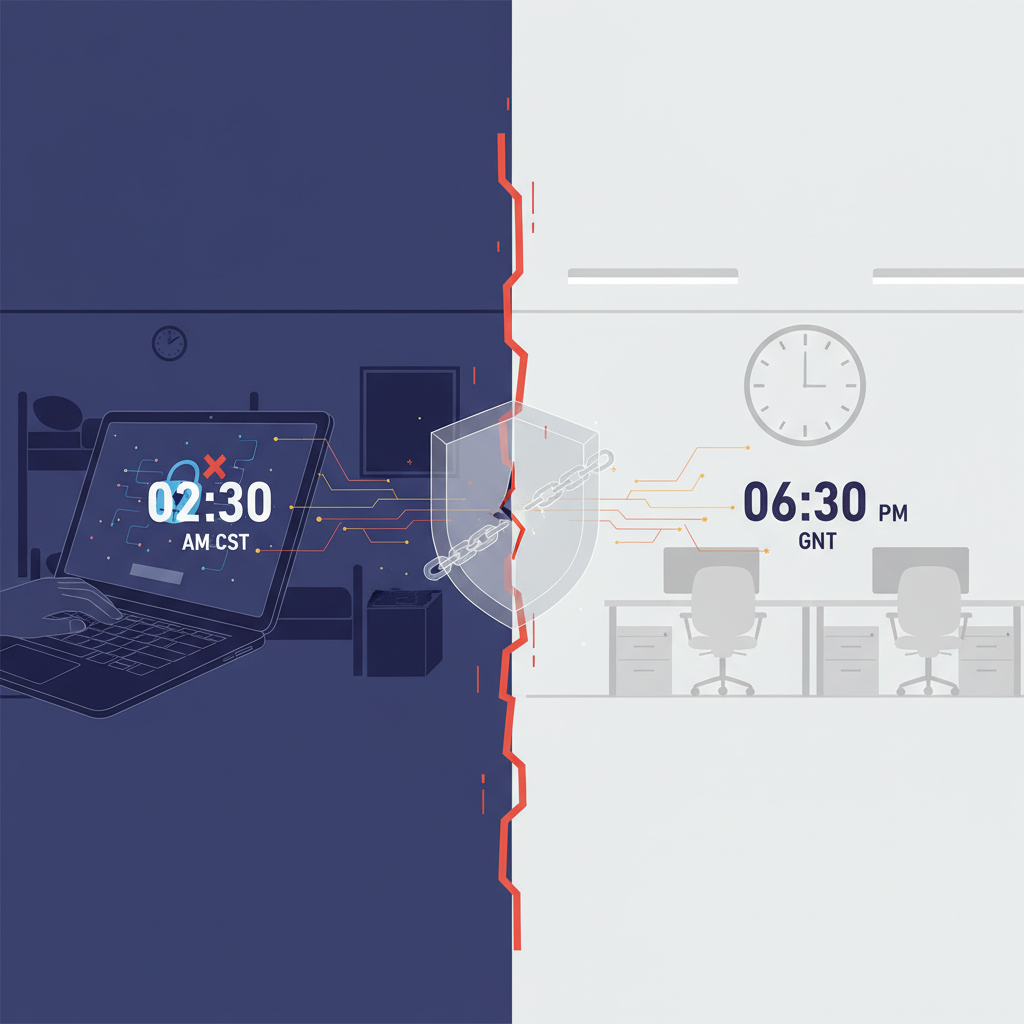
Executive Summary: A new arXiv paper reveals that stringent university cybersecurity measures—such as MFA, device compliance, and remote management—disproportionately block international students in UK-China transnational programmes due to time-zone gaps and lack of real-time IT support, exposing a critical flaw in co-located security assumptions.
Why It Matters
The paper highlights a growing tension in higher education cybersecurity: as institutions strengthen defenses against credential theft, ransomware, and data breaches, they inadvertently create accessibility barriers that fall hardest on international students in transnational programmes. While security measures like MFA and endpoint compliance are necessary responses to rising threats, their implementation often ignores the operational realities of globally distributed learners. For students in China accessing UK-hosted virtual learning environments, the 8-hour time difference means that when authentication fails or a device is flagged as non-compliant, there is no local IT helpdesk available during their waking hours to resolve the issue in real time. This transforms security from a protective measure into a functional denial of service.
The research is grounded in qualitative evidence from student-reported experiences across public platforms and institutional help channels, lending credibility to claims of systemic inaccessibility. Unlike theoretical risk assessments, this work documents actual service disruptions—authentication failures, device lockouts, and browser incompatibilities—that prevent students from participating in coursework, submitting assignments, or accessing learning materials. These are not edge cases but recurring patterns reported across multiple UK-China partnership programmes, suggesting a design flaw rather than isolated incidents.
Technical Signal
Importantly, the paper does not argue against strong cybersecurity in universities. Instead, it calls for a reevaluation of security architecture through an accessibility and equity lens. The assumption that users are co-located, operating within standard business hours in a single time zone, and able to access physical support infrastructure is increasingly invalid in the context of global education. This model fails not only international students but also on-campus learners who may study outside traditional hours or use non-standard devices.
For global cybersecurity, AI, and cloud infrastructure teams, this case offers a cautionary tale about the unintended consequences of centralized, rigid security policies. As more educational and corporate services move to hybrid and distributed models, security teams must design for asynchronous access, variable device ecosystems, and limited real-time support. Solutions may include time-zone-aware helpdesk routing, self-service recovery tools with strong identity verification, and exception processes for verified international users that do not weaken overall security posture.
Operational Impact
The findings also resonate beyond education. Multinational enterprises with remote workers in Asia, Africa, or Latin America face similar challenges when headquarters-centric security controls—such as conditional access policies tied to specific regions or device management requirements—block legitimate users. The paper supports a broader principle: security effectiveness must be measured not only by threat reduction but also by availability to authorized users across diverse operating contexts.
Finally, while the paper focuses on UK-China dynamics, its implications are globally relevant. Any institution delivering digital services to a geographically dispersed user base must evaluate whether its security controls assume synchronous support availability. As transnational education and remote work continue to grow, security frameworks that cannot adapt to time, location, and support variability will increasingly impede access—undermining both usability and trust in digital systems.
What To Watch
A useful way to read this paper is as research evidence rather than as a deployment recommendation. The source page gives a paper title, abstract-level framing, and publication metadata; it does not by itself prove production readiness, market adoption, attacker behavior, or incident impact. Nogosee therefore treats the work as a signal for research monitoring: the question is what education, cybersecurity can learn from the method, the assumptions, and the stated limitations, not whether the paper should immediately change controls.
For practitioners, the first review step is to separate the paper's stated contribution from operational interpretation. If the abstract describes a method, framework, measurement, or evaluation, that contribution can help teams decide what to watch next. It should not be converted into claims about real-world compromise, confirmed defense effectiveness, or regional adoption unless the paper itself supplies that evidence. This boundary is especially important for AI-security and cyber-operations research, where promising prototypes can sound more mature than they are.
The paper is still useful for a tracker because it creates vocabulary and comparison points. Tags such as university security, MFA, international students, UK-China partnership, accessibility, transnational education help future records connect related work across advisories, tools, source-code releases, benchmarks, and operational reports. If later sources mention similar techniques or reuse the same assumptions, the research brief becomes part of a larger evidence trail instead of a one-off academic summary.
Event Type: security
Importance: medium
Affected Sectors
- cybersecurity
- education
Key Numbers
- Time difference cited in paper: 8 hours
- Paper submission date: 2026-05-19
Timeline
- Paper submitted to arXiv by Benjamin Kenwright
- Paper fetched and indexed by Nogosee Intelligence
Frequently Asked Questions
Why are UK-China partnership students disproportionately affected by university cybersecurity measures?
Students in China accessing UK university systems face an 8-hour time difference with no real-time IT support during their active hours, turning security protocols like MFA and device compliance into functional barriers when authentication fails or devices are locked out.
What specific security measures are creating accessibility issues for international students?
Mandatory multi-factor authentication (MFA), device compliance rules, browser and operating system restrictions, and administrative remote-management permissions on personal devices are cited as key security measures that hinder access, especially when local IT support is unavailable.
Does the paper suggest that on-campus students are unaffected by these security measures?
No, the paper states that on-campus students also face significant barriers from these measures, but they can mitigate issues by visiting IT desks or using library terminals—options unavailable to remote international learners.
What is the core argument of the paper regarding university security models?
Current university security models assume a co-located, 9-to-5, English-time-zone user, which fails both domestic students and catastrophically disadvantages international partnership cohorts who lack synchronous support access.
What sources did the paper use to gather evidence on student experiences?
The paper draws on testimonies from public forums including Reddit’s r/college, r/UniUK, and r/Professors, higher education IT help boards, and direct student accounts from UK-China transnational education programmes.