Answer Brief
Use Nogosee’s public procurement and MOPS incident records to compare cybersecurity spending signals with disclosed incidents in Taiwan as separate data streams. This workflow guides security, risk, and procurement teams to independently review tenders, awards, and incident statements without implying causation, using Nogosee as a monitoring layer for source verification and contextual review.
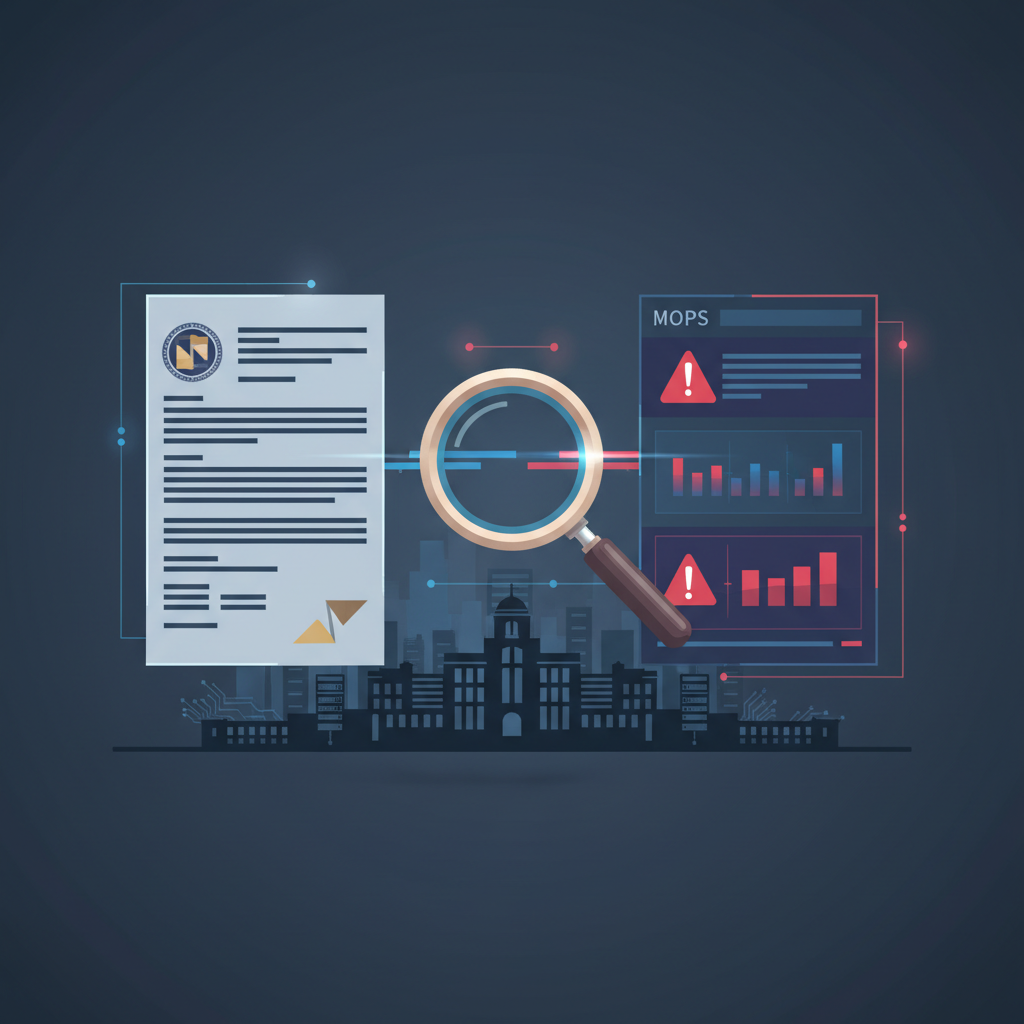
Executive Summary: Use Nogosee’s public procurement and MOPS incident records to compare cybersecurity spending signals with disclosed incidents in Taiwan as separate data streams. This workflow guides security, risk, and procurement teams to independently review tenders, awards, and incident statements without implying causation, using Nogosee as a monitoring layer for source verification and contextual review.
Why It Matters
This workflow supports security, risk, and procurement teams in Taiwan who need to independently review cybersecurity spending awards and public incident disclosures as separate signal types. Nogosee’s tracker aggregates government procurement records and MOPS (Market Observation Post System) incident statements, allowing users to search, export, and monitor these records without implying that spending levels cause or prevent security outcomes. The process begins with a targeted search in Nogosee using filters for Taiwan, procurement awards, and incident disclosures, limited to the Taiwan region and relevant sectors such as technology, government, and critical infrastructure. Users should open each source-linked record to verify the original public notice, checking dates, entities, and award values or incident descriptions before proceeding.
Once records are collected, the next step is to export the data using Nogosee’s capped CSV or indicator CSV functions for offline review. Teams should avoid treating the tracker as a complete census; instead, use the export as a sample for internal validation. In the exported data, procurement records typically include tender titles, awarding entities, suppliers, and contract values, while incident disclosures contain company names, incident dates, brief statements, and reference numbers. These should be reviewed in parallel, not merged, to preserve the integrity of each signal type.
Technical Signal
Decision criteria should focus on data completeness and source verifiability, not on matching spending to incident frequency. For example, a high-value cybersecurity award to a Taiwan-based systems integrator should be checked against the MOPS database for any incident statements from that supplier or its known clients—but only to confirm whether such disclosures exist, not to assume a gap implies risk. Similarly, a public incident disclosure from a listed company should be traced back to procurement records to see if related cybersecurity awards were recently made, again without asserting causation.
Ownership of this workflow should be shared: procurement or vendor management teams can validate award accuracy and supplier eligibility; security operations or SOC teams can assess the credibility and technical detail of incident disclosures; risk or audit leads can coordinate the comparison and document findings for internal governance reviews. Escalation should be considered not when spending and incidents diverge, but when records appear missing, inconsistent, or unverifiable—for instance, if a major incident is disclosed but no corresponding procurement record exists for related controls, prompting a check of disclosure timing or source coverage.
Operational Impact
Finally, teams should use the results to inform follow-up actions such as supplier questionnaires, control validation requests, or updates to third-party risk monitoring lists—not to conclude that spending was adequate or inadequate. The workflow’s value lies in creating a repeatable, source-grounded process for comparing public signals in Taiwan, helping teams maintain situational awareness while respecting the boundaries of what public disclosures can and cannot reveal.
Treat the official source as a monitoring input, not as proof that every feed entry deserves a public article. The practical value is a repeatable triage layer: capture the source title, original URL, visible publication date, affected product or service when available, and the operational surface involved. When those fields are thin or ambiguous, the item should stay in the tracker as monitoring data rather than becoming a standalone post.
What To Watch
For readers watching Taiwan, the escalation question is whether the notice touches a real local, national, regional, sector, or operating dependency. Supplier exposure, cloud identity, telecom, financial services, government systems, semiconductor or manufacturing links, public-sector technology, managed service providers, and internet-facing infrastructure are strong signals even before global media frames them as cross-border events.
A healthy workflow separates three outcomes. Routine items become searchable tracker records. Items with clear patch urgency, exploitation language, named affected technology, or cross-border supplier relevance become article candidates. Items that are old, duplicated, underspecified, or mostly vendor boilerplate should remain monitor-only even if they contain familiar cybersecurity keywords.
The useful reader task is comparison. Analysts should ask whether the same vendor, CVE family, attack surface, sector, or region appears across multiple sources. A single notice can be weak by itself, while a cluster across CERT, vendor, and security research sources can justify a higher-priority brief. Nogosee should preserve that distinction so the site behaves like an intelligence tracker instead of a rewrite feed.
Event Type: security
Importance: medium
Affected Sectors
- critical infrastructure
- government
- technology
Frequently Asked Questions
How should I treat Nogosee’s procurement and incident records when comparing them?
Treat procurement awards and incident disclosures as separate signal types. Do not infer spending caused incidents or vice versa. Use Nogosee to locate and verify each record type independently, then review them side-by-side for contextual awareness only.
Who should own the workflow of comparing procurement and incident data in Taiwan?
Security operations, supplier risk, and governance teams should share ownership. Procurement teams can validate award data; security teams verify incident disclosures; risk leads synthesize findings for internal review without asserting causal links.
When should I escalate a mismatch between high procurement spending and low incident disclosures in Taiwan?
Consider escalation when sustained high-value cybersecurity awards coincide with zero public incident disclosures over multiple quarters, prompting a review of disclosure thresholds or reporting gaps—not as proof of hidden incidents, but as a signal to verify monitoring coverage.
What are the next steps after exporting Taiwan procurement and MOPS incident data from Nogosee?
Clean and deduplicate records by entity and date, then map procurement awards to suppliers and incident disclosures to affected organizations. Use the results to inform supplier risk assessments and internal control reviews, not to conclude exposure or liability.
Can I use Nogosee’s Taiwan public signals to prove that procurement spending prevents incidents?
No. Nogosee provides monitoring access to public records only. Comparing procurement and incident data supports situational awareness, not effectiveness claims. Any inference about prevention or failure requires internal audit, control testing, or third-party assessment beyond the tracker’s scope.