Answer Brief
MolTrust implements a production trust infrastructure for autonomous AI agents using W3C Verifiable Credentials and DIDs, with 69,000 bots processing 165 million transactions worth $50M USDC on Base Layer 2 since March 2026, featuring kernel-level authorization enforcement and cross-protocol interoperability.
Signal Timeline
A quick visual path for analysts before reading the full brief.
- 1
MolTrust reference implementation became operational
- 2
Paper submitted to arXiv documenting deployment and capabilities
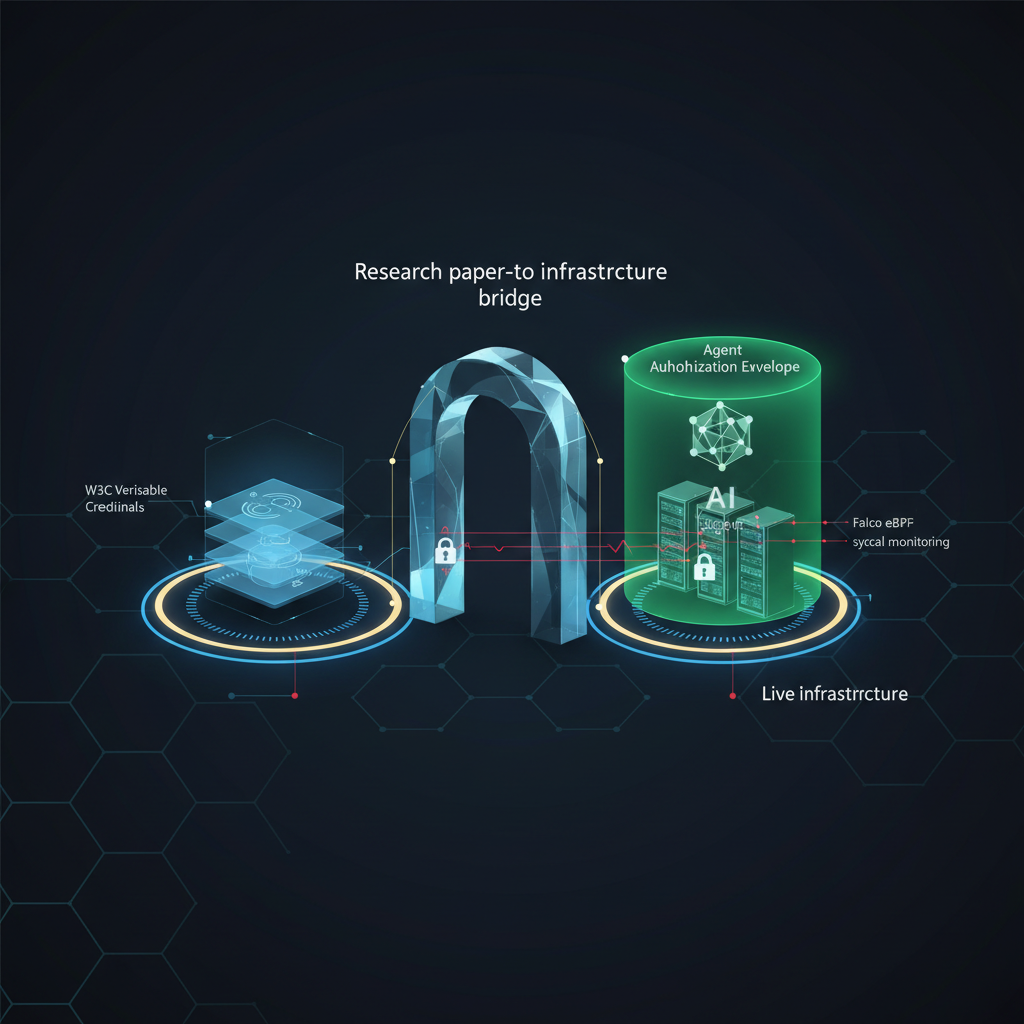
Executive Summary: MolTrust implements a production trust infrastructure for autonomous AI agents using W3C Verifiable Credentials and DIDs, with 69,000 bots processing 165 million transactions worth $50M USDC on Base Layer 2 since March 2026, featuring kernel-level authorization enforcement and cross-protocol interoperability.
Why It Matters
MolTrust represents a significant advancement in establishing trust for autonomous AI agent ecosystems by implementing a production-grade infrastructure based on open W3C standards. The system addresses a critical gap identified by regulators including Singapore's IMDA, NIST CAISI, and the EU AI Act, as well as industry leaders like Anthropic and Google, who have independently concluded that no single vendor can provide the necessary open, portable, and cryptographically verifiable trust layer required for scalable agent interactions. By anchoring on Base Layer 2 and utilizing W3C Verifiable Credentials and DIDs, MolTrust achieves vendor-neutral interoperability while maintaining cryptographic integrity.
The technical architecture centers on four core primitives—identity, authorization, behavioral record, and portability—supported by a five-party accountability chain and the Agent Authorization Envelope (AAE). The AAE is particularly notable for its three-layer enforcement model: cryptographic signatures for transaction integrity, API-level credential lifecycle management for issuance and revocation control, and kernel-level syscall monitoring via Falco eBPF. This deepest layer operates below the agent process boundary, ensuring that even if an agent is compromised at the application level, malicious actions violating its authorization are blocked at the operating system level, a rare and valuable property in agent security.
Technical Signal
Empirical evidence from real-world deployment shows substantial adoption: since March 2026, 69,000 autonomous bots have executed 165 million transactions across eight credential verticals, moving a cumulative volume of 50 million USDC. This scale demonstrates that the infrastructure can support production workloads beyond theoretical or testnet environments. The system's cross-protocol interoperability was validated through five reproducible test vectors confirmed against independent implementations, indicating robust adherence to W3C standards and reducing vendor lock-in risks.
For security and operations teams, MolTrust introduces a new paradigm in agent-centric security where trust is not assumed but continuously verified through cryptographic and behavioral mechanisms. The kernel-level enforcement via eBPF creates a trusted execution environment for agent actions, which could inform future secure agent runtimes. The layered Sybil resistance approach—combining interaction proofs, cross-endorsement diversity, and violation persistence tied to principal DIDs—addresses identity spoofing and reputation manipulation without relying on centralized authorities.
Operational Impact
While the paper notes that empirical validation at adversarial scale is pending, the current deployment provides deployment-first evidence that the trust infrastructure called for by regulators and AI labs is implementable today using existing standards. Teams monitoring AI agent security, decentralized identity, or blockchain-based access control should watch for how such infrastructures handle key lifecycle, revocation propagation, and performance under load, as well as emerging threats targeting the eBPF monitoring layer or credential issuance points.
A useful way to read this paper is as research evidence rather than as a deployment recommendation. The source page gives a paper title, abstract-level framing, and publication metadata; it does not by itself prove production readiness, market adoption, attacker behavior, or incident impact. Nogosee therefore treats the work as a signal for research monitoring: the question is what AI agents, blockchain, identity management, cybersecurity can learn from the method, the assumptions, and the stated limitations, not whether the paper should immediately change controls.
What To Watch
For practitioners, the first review step is to separate the paper's stated contribution from operational interpretation. If the abstract describes a method, framework, measurement, or evaluation, that contribution can help teams decide what to watch next. It should not be converted into claims about real-world compromise, confirmed defense effectiveness, or regional adoption unless the paper itself supplies that evidence. This boundary is especially important for AI-security and cyber-operations research, where promising prototypes can sound more mature than they are.
The paper is still useful for a tracker because it creates vocabulary and comparison points. Tags such as W3C Verifiable Credentials, Decentralized Identifiers, Agent Authorization Envelope, Base Layer 2, Falco eBPF, Sybil resistance help future records connect related work across advisories, tools, source-code releases, benchmarks, and operational reports. If later sources mention similar techniques or reuse the same assumptions, the research brief becomes part of a larger evidence trail instead of a one-off academic summary.
Readers should also look for what the visible source does not answer. Abstracts often summarize goals and results but omit implementation detail, dataset caveats, reproducibility constraints, threat-model boundaries, and evaluation failure cases. A cautious digest should preserve those unknowns. When those details matter for procurement, detection engineering, SOC workflow, or AI governance, the next task is to inspect the full paper and any linked code or artifact rather than relying on a summary alone.
Event Type: security
Importance: high
Affected Sectors
- AI agents
- blockchain
- cybersecurity
- identity management
Key Numbers
- Autonomous AI agents deployed: 69,000 bots
- Transactions processed: 165 million
- Cumulative transaction volume: 50 million USDC
- Credential verticals covered: 8
- Operational since: March 2026
Timeline
- MolTrust reference implementation became operational
- Paper submitted to arXiv documenting deployment and capabilities
Frequently Asked Questions
What is MolTrust and what problem does it solve for autonomous AI agents?
MolTrust is a production-deployed trust infrastructure for autonomous AI agents built on W3C Verifiable Credentials 2.0 and Decentralized Identifiers v1.0. It solves the lack of a shared trust layer by providing cryptographically verifiable identity, authorization, behavioral records, and portability across agents transacting without centralized intermediaries.
How does MolTrust enforce authorization at the kernel level?
MolTrust enforces the Agent Authorization Envelope (AAE) at the kernel level via Falco eBPF integration, monitoring syscalls below the agent process boundary to prevent unauthorized actions even if the agent is compromised, providing a hardware-enforced security layer.
What evidence supports MolTrust's cross-protocol interoperability and Sybil resistance?
MolTrust demonstrates cross-protocol interoperability through five reproducible test vectors verified against independent implementations. Its layered Sybil resistance combines dual-signature interaction proofs, cross-vertical endorsement diversity gating, and principal-DID-linked violation persistence to deter fake identity attacks.