Answer Brief
Nogosee's tracker-first policy allows monitor-only records to remain valuable through scoring, filtering, and brief queues without forcing weak signals into full articles. This workflow guides security, cloud, and operations teams on how to use the East Asia Cyber & AI Risk Tracker for repeatable monitoring, verification, and escalation while preserving source integrity and avoiding low-value publishing.
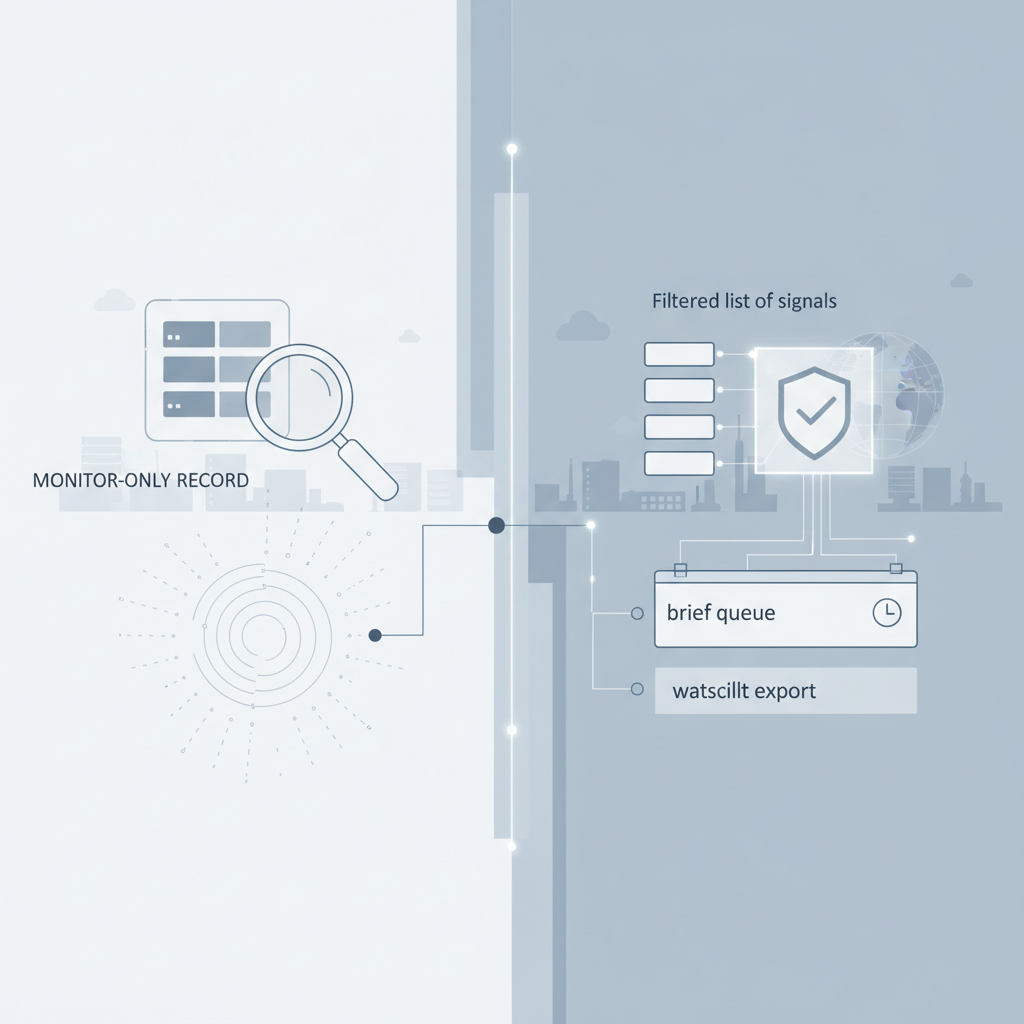
Executive Summary: Nogosee's tracker-first policy allows monitor-only records to remain valuable through scoring, filtering, and brief queues without forcing weak signals into full articles. This workflow guides security, cloud, and operations teams on how to use the East Asia Cyber & AI Risk Tracker for repeatable monitoring, verification, and escalation while preserving source integrity and avoiding low-value publishing.
Why It Matters
Nogosee’s tracker-first publishing policy is designed to preserve the utility of monitor-only records without compromising content quality by turning weak signals into thin, indexable articles. The East Asia Cyber & AI Risk Tracker functions as a monitoring layer where public signals — including CERT advisories, procurement disclosures, and incident statements — are normalized, enriched with metadata, and made searchable. Not every signal warrants a full article; many are valuable precisely because they remain as monitor-only records that support verification, context-building, and trend-spotting without overextending editorial resources. This approach ensures that the tracker remains a high-signal intelligence resource rather than a repository of low-value, repetitive content.
The workflow begins with search: users start by querying the database using country, CVE, company, sector, or threat theme such as ransomware, JVN, KrCERT, procurement, or AI security. Once results appear, the next step is to inspect signals — opening source-linked records, comparing priority, checking dates, and using related collection pages for context. This inspection phase is critical for determining whether a record should remain in monitoring, be exported for watchlist use, or escalated to a brief or article based on emerging patterns.
Technical Signal
For records that do not meet article thresholds, the recommended action is to keep them in monitoring and re-check when related signals appear in the same region or sector. This is reflected in the tracker’s triage matrix, which advises users to maintain monitor-only status until corroborating evidence emerges. This prevents premature escalation while preserving the record’s utility for future analysis. Teams can use capped CSV, indicator CSV, RSS feeds, or copyable briefs to integrate these records into existing workflows, such as SIEM enrichment, vendor risk assessments, or regional threat hunting.
Ownership of this workflow lies with the teams using the tracker — security, cloud, governance, supplier-risk, and research teams — who are responsible for applying their own risk thresholds and escalation criteria. Nogosee does not impose hard rules like ‘must escalate after X days’ or ‘only include if Y threshold is met.’ Instead, it encourages flexible, context-driven language such as ‘consider including,’ ‘route for review,’ or ‘keep in monitoring until more context appears.’ This allows teams to adapt the tracker to their internal processes without being constrained by arbitrary numeric thresholds.
Operational Impact
Escalation to article status occurs only after internal quality checks pass, ensuring that published briefs are grounded in verified detail, novelty, and operational relevance. Until then, monitor-only records serve their purpose by being traceable to original sources, comparable across time and geography, and useful for validating whether a signal is isolated or part of a broader trend. The tracker’s transparency about its coverage — core focus on Taiwan, Japan, and Korea, with selected watchlists for China, Singapore, Philippines, Thailand, and global risk — helps users understand the scope of what is being monitored and where gaps may exist.
Finally, the tracker emphasizes verification: treat Nogosee as a monitoring layer, not a source of truth. Always open the linked source, compare nearby tracker records, and check methodology and update cadence before making operational decisions. This discipline ensures that monitor-only records are used responsibly — as starting points for inquiry, not as conclusions. By following this workflow, teams can maintain high-fidelity monitoring of East Asia cyber and AI risk signals without contributing to information noise or sacrificing analytical depth.
What To Watch
Treat the official source as a monitoring input, not as proof that every feed entry deserves a public article. The practical value is a repeatable triage layer: capture the source title, original URL, visible publication date, affected product or service when available, and the operational surface involved. When those fields are thin or ambiguous, the item should stay in the tracker as monitoring data rather than becoming a standalone post.
For readers watching East Asia, the escalation question is whether the notice touches a real local, national, regional, sector, or operating dependency. Supplier exposure, cloud identity, telecom, financial services, government systems, semiconductor or manufacturing links, public-sector technology, managed service providers, and internet-facing infrastructure are strong signals even before global media frames them as cross-border events.
A healthy workflow separates three outcomes. Routine items become searchable tracker records. Items with clear patch urgency, exploitation language, named affected technology, or cross-border supplier relevance become article candidates. Items that are old, duplicated, underspecified, or mostly vendor boilerplate should remain monitor-only even if they contain familiar cybersecurity keywords.
Event Type: security
Importance: medium
Affected Sectors
- cloud
- governance
- research
- security
- supplier-risk
Frequently Asked Questions
What is a monitor-only record in the Nogosee tracker?
A monitor-only record is a public signal preserved in the tracker for verification and context that does not meet the threshold for a full article due to limited detail, novelty, or operational impact. It remains searchable and useful for monitoring, cross-referencing, and source verification without being turned into a thin or low-value article.
How should teams use monitor-only records without creating thin articles?
Teams should use scoring, filters, and brief queues to assess monitor-only records for relevance, freshness, and related signals. Keep them in monitoring queues, re-check when similar signals appear in the same region or sector, and use them for source verification and watchlist building — only escalate to article status when quality checks pass and deeper context is needed.
Who is responsible for deciding when a monitor-only record becomes an article?
The Nogosee editorial workflow applies quality checks before publishing any record as a public article. Teams using the tracker should treat monitor-only records as monitoring inputs, not article candidates, and rely on the tracker’s internal review process to determine when a signal deserves deeper review and article publication.
What actions should be taken when a monitor-only record appears in the tracker?
Open the linked source, compare nearby tracker records for context, check methodology and update cadence, and use the triage matrix to decide whether to keep the record in monitoring, export it for watchlists, or re-check when related signals emerge in the same sector or region. Avoid treating monitor-only records as incidents or trends without corroborating signals.
How does the Nogosee tracker support repeatable workflows for security and operations teams?
The tracker supports repeatable workflows through capped CSV and RSS exports, copyable briefs, local watchlists, and advanced filtering by country, CVE, sector, or threat theme. Teams can save queries, export indicator data, and use the request form for larger data access — all while treating the tracker as a monitoring layer, not a source of ground truth.