Answer Brief
Use Nogosee's public tracker to assess East Asia vulnerability signals by verifying asset exposure, supplier impact, exploitability evidence, business ownership, compensating controls, and monitoring needs before escalation.
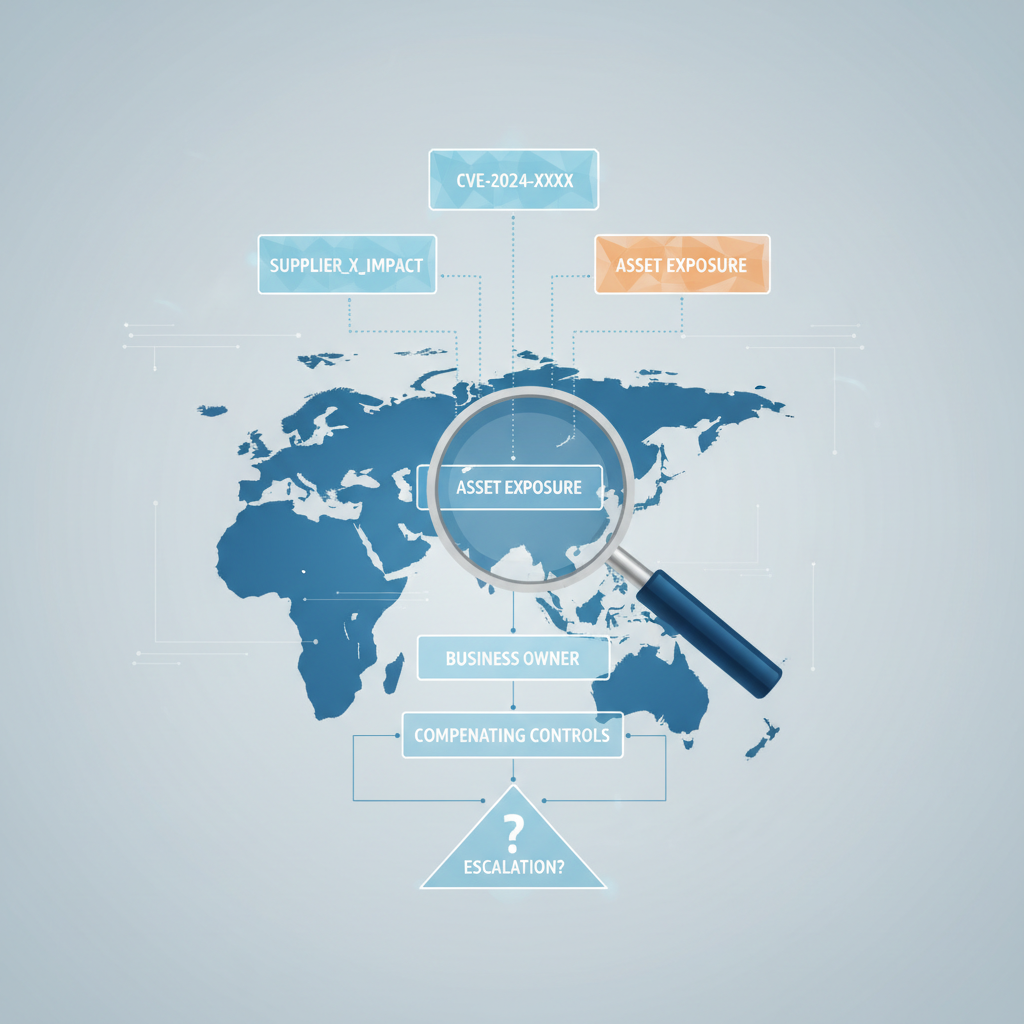
Executive Summary: Use Nogosee's public tracker to assess East Asia vulnerability signals by verifying asset exposure, supplier impact, exploitability evidence, business ownership, compensating controls, and monitoring needs before escalation.
Why It Matters
Nogosee's public tracker serves as a foundational resource for monitoring East Asia cyber and AI risk signals, particularly vulnerability disclosures from regional sources like JVN, KrCERT, and government procurement records. Before escalating any signal, teams must first conduct a targeted search using identifiable attributes such as CVE identifiers, company names, sector tags, or threat themes like ransomware or AI security. This ensures the signal is correctly located within the structured database, which normalizes RSS feeds and source-list items into enriched records with entities, sectors, tags, and primary-source links. The initial search step is critical to avoid noise and focus on relevant, first-hand regional intelligence.
Once a signal is located, the next step involves inspecting the source-linked records in detail. Teams should open the associated records, compare their priority levels, check publication and discovery dates, and consult related collection pages when additional context is needed. This inspection phase helps distinguish between low-value monitoring records and signals that warrant deeper analysis. The tracker’s design allows users to export data via capped CSV, indicator CSV, or RSS feeds, supporting repeatable workflows without overloading systems with unnecessary data pulls.
Technical Signal
Escalation decisions should not be based on automated triggers but on a structured review of six key factors: asset exposure (whether internal systems are affected), affected supplier status (if third-party components are involved), exploitability evidence (proof-of-concept, active exploitation, or weaponization), clear business ownership (who is accountable for the asset or service), compensating controls (existing mitigations that may reduce risk), and the need for ongoing source monitoring (whether the signal is part of an evolving threat). These criteria ensure that escalation is proportionate, informed, and aligned with operational risk management.
The business owner plays a central role in this process. They must be identified early and engaged in the review, as they possess the contextual knowledge to judge real-world impact, downtime tolerance, and remediation feasibility. Escalation should not occur in isolation from operational stakeholders; instead, it should be a collaborative step where technical findings are weighed against business continuity and service-level considerations.
Operational Impact
Compensating controls—such as network segmentation, intrusion prevention systems, or access restrictions—must be evaluated before escalation. Their presence may reduce urgency, even if a vulnerability is technically severe. Conversely, their absence or weakness can elevate risk, especially when combined with exploitability evidence. This assessment prevents alert fatigue and ensures that escalation reflects true residual risk rather than theoretical severity.
Finally, teams should establish a follow-up monitoring plan regardless of the escalation outcome. Using Nogosee’s export functions—such as RSS alerts, CSV downloads, or saved watchlists—enables continuous tracking of the signal and related themes. Preserving the original source link supports auditability and future reference. The process emphasizes flexibility over rigid rules: teams should consider including a signal in review, route unclear items for further verification, and maintain monitoring until more context emerges, rather than applying fixed thresholds or mandatory escalation paths.
What To Watch
Treat the official source as a monitoring input, not as proof that every feed entry deserves a public article. The practical value is a repeatable triage layer: capture the source title, original URL, visible publication date, affected product or service when available, and the operational surface involved. When those fields are thin or ambiguous, the item should stay in the tracker as monitoring data rather than becoming a standalone post.
For readers watching East Asia, the escalation question is whether the notice touches a real local, national, regional, sector, or operating dependency. Supplier exposure, cloud identity, telecom, financial services, government systems, semiconductor or manufacturing links, public-sector technology, managed service providers, and internet-facing infrastructure are strong signals even before global media frames them as cross-border events.
A healthy workflow separates three outcomes. Routine items become searchable tracker records. Items with clear patch urgency, exploitation language, named affected technology, or cross-border supplier relevance become article candidates. Items that are old, duplicated, underspecified, or mostly vendor boilerplate should remain monitor-only even if they contain familiar cybersecurity keywords.
The useful reader task is comparison. Analysts should ask whether the same vendor, CVE family, attack surface, sector, or region appears across multiple sources. A single notice can be weak by itself, while a cluster across CERT, vendor, and security research sources can justify a higher-priority brief. Nogosee should preserve that distinction so the site behaves like an intelligence tracker instead of a rewrite feed.
Event Type: security
Importance: medium
Frequently Asked Questions
What is the first step when reviewing an East Asia vulnerability signal in Nogosee's tracker?
Start by searching the database using a country, CVE, company, sector, source family, or threat theme such as ransomware, JVN, KrCERT, procurement, or AI security to locate the signal.
How should teams determine if a signal needs deeper review after initial search?
Open source-linked records, compare priority, check dates, and use related collection pages when a record requires additional context for assessment.
What factors should be evaluated before deciding to escalate a vulnerability signal?
Assess asset exposure, affected supplier status, exploitability evidence, business owner accountability, compensating controls in place, and the need for ongoing source monitoring.
Who should own the decision to escalate a vulnerability signal from the tracker?
The relevant business or system owner should be identified and involved in the escalation decision, as they understand operational impact and risk tolerance.
What should teams do after evaluating a signal but before finalizing escalation?
Continue monitoring the source for updates, use capped CSV or RSS feeds for repeat workflows, and preserve the original source link for verification and audit trails.