Answer Brief
This checklist guides security teams on how to responsibly capture and verify key details from ransomware leak posts before internal sharing, including timestamps, claimed victims, proof files, and validation steps, while avoiding amplification of unverified claims. It supports East Asia cyber risk monitoring by promoting disciplined handling of dark-web intelligence.
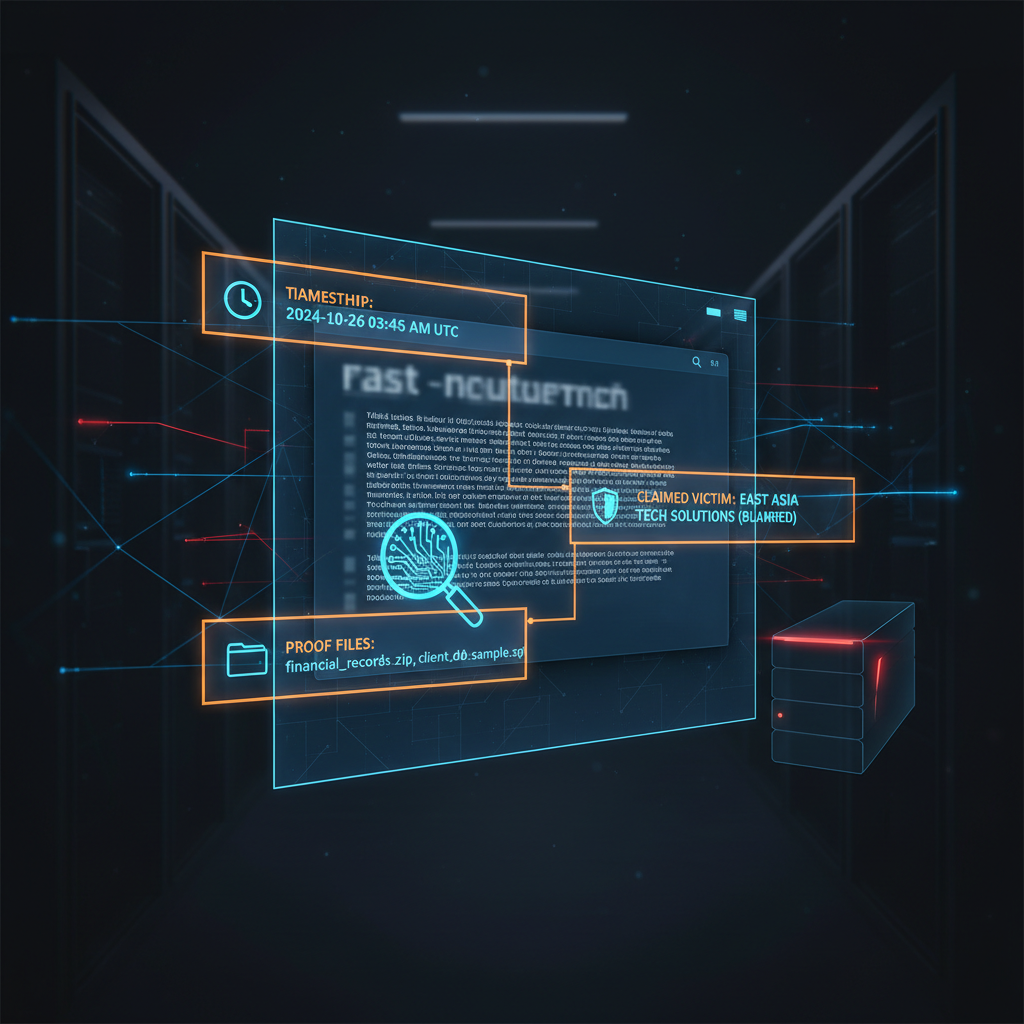
Executive Summary: This checklist guides security teams on how to responsibly capture and verify key details from ransomware leak posts before internal sharing, including timestamps, claimed victims, proof files, and validation steps, while avoiding amplification of unverified claims. It supports East Asia cyber risk monitoring by promoting disciplined handling of dark-web intelligence.
Why It Matters
This checklist supports security teams in East Asia and beyond who encounter ransomware leak posts on dark-web forums or messaging platforms. The first step is to capture the post’s timestamp and preserve its source—whether via screenshot, archive link, or metadata—without altering the original content. This creates an auditable record that can be revisited if the claim evolves or is later disproven. Teams should avoid sharing the raw post internally until basic verification steps are taken, to prevent spreading unconfirmed allegations that could trigger unnecessary alarm or reputational harm.
Next, identify any claimed victims named in the post. Rather than accepting the claim at face value, security teams should attempt to corroborate the victim’s identity through independent channels: checking for official breach notices, reviewing recent SEC filings or regulatory disclosures, or consulting trusted intelligence feeds. If no confirmation exists, the victim should be labeled as 'alleged' in internal documentation, and sharing should be limited to those with a need to know, accompanied by clear caveats about uncertainty.
Technical Signal
The checklist then advises recording any proof files the threat actor displays—such as screenshots of directories, sample documents, or database tables. Teams should note the file names, types, and sizes described in the post, but refrain from downloading or opening these files unless in a secure, isolated environment managed by malware analysis or digital forensics specialists. This prevents accidental exposure to malicious content while preserving awareness of what data is allegedly at risk.
Verification steps include comparing the leak’s timing with known incidents, checking for similar claims across multiple leak sites, and assessing whether the threat actor’s language or tactics match prior behavior. Teams should also monitor for updates to the post—such as new file dumps or revised claims—and adjust their assessment accordingly. Throughout this process, the focus remains on risk tracking, not confirmation of breach.
Operational Impact
Finally, the checklist emphasizes using Nogosee’s tracker as a contextual tool. By searching for related signals—such as past incidents involving the same company, sector, or threat actor—teams can determine whether the leak fits a pattern or appears anomalous. The tracker’s public signals, CSV exports, and source links allow for deeper review when a signal warrants investigation. Teams are reminded to treat Nogosee as a monitoring layer: verify the source, check update frequency, and review methodology before making operational decisions. This approach ensures that internal sharing of leak intelligence is both informed and cautious, supporting better situational awareness without amplifying noise.
Treat the official source as a monitoring input, not as proof that every feed entry deserves a public article. The practical value is a repeatable triage layer: capture the source title, original URL, visible publication date, affected product or service when available, and the operational surface involved. When those fields are thin or ambiguous, the item should stay in the tracker as monitoring data rather than becoming a standalone post.
What To Watch
For readers watching East Asia, the escalation question is whether the notice touches a real local, national, regional, sector, or operating dependency. Supplier exposure, cloud identity, telecom, financial services, government systems, semiconductor or manufacturing links, public-sector technology, managed service providers, and internet-facing infrastructure are strong signals even before global media frames them as cross-border events.
A healthy workflow separates three outcomes. Routine items become searchable tracker records. Items with clear patch urgency, exploitation language, named affected technology, or cross-border supplier relevance become article candidates. Items that are old, duplicated, underspecified, or mostly vendor boilerplate should remain monitor-only even if they contain familiar cybersecurity keywords.
The useful reader task is comparison. Analysts should ask whether the same vendor, CVE family, attack surface, sector, or region appears across multiple sources. A single notice can be weak by itself, while a cluster across CERT, vendor, and security research sources can justify a higher-priority brief. Nogosee should preserve that distinction so the site behaves like an intelligence tracker instead of a rewrite feed.
For structured coverage, tag each record consistently by region, source, sector, technology surface, and monitoring status. That makes the database useful even on quiet news days because readers can still filter for security-operations, incident-response, threat-intelligence, inspect current watchlist records, and decide which official source deserves direct follow-up.
Event Type: security
Importance: medium
Affected Sectors
- incident-response
- security-operations
- threat-intelligence
Frequently Asked Questions
What should I capture first when reviewing a ransomware leak post?
Start by recording the exact timestamp of the post’s publication, including timezone if available, and preserve the original URL or archived copy. This establishes a baseline for tracking changes or updates to the leak claim over time.
How do I verify claimed victims in a ransomware leak post without amplifying unverified information?
Cross-reference the claimed victim name with official statements, regulatory filings, or trusted threat intelligence feeds. Avoid sharing the claim internally until some form of corroboration exists, and label unverified claims as 'alleged' or 'unconfirmed' in any internal notes.
What proof files should I look for in a ransomware leak post, and how should I handle them?
Identify any files the threat actor claims to have stolen—such as screenshots, document samples, or database exports—and record their filenames, types, and sizes. Do not download or open unverified files; instead, note their presence for later analysis by a qualified team in a controlled environment.
When should I escalate a ransomware leak post for further investigation?
Escalate if the post includes verifiable proof (e.g., matching internal data), if the victim is a critical supplier or partner, or if the leak coincides with other suspicious activity. Use flexible judgment based on context, not rigid thresholds.
How can I use Nogosee’s tracker when reviewing a ransomware leak post?
Use Nogosee to search for related signals—such as prior incidents involving the same victim, sector, or threat actor—and compare timestamps and details. Treat the tracker as a monitoring layer: open linked sources, check update cadence, and verify methodology before acting.