Answer Brief
This guide provides a step-by-step workflow for security teams to build and maintain a vendor exposure map using Nogosee’s East Asia Cyber & AI Risk Tracker as a monitoring layer. It covers essential fields to track, duplicate handling, escalation triggers, and monitoring practices without implying numeric thresholds or rigid rules. Designed for repeatable use by security, cloud, and supplier-risk teams.
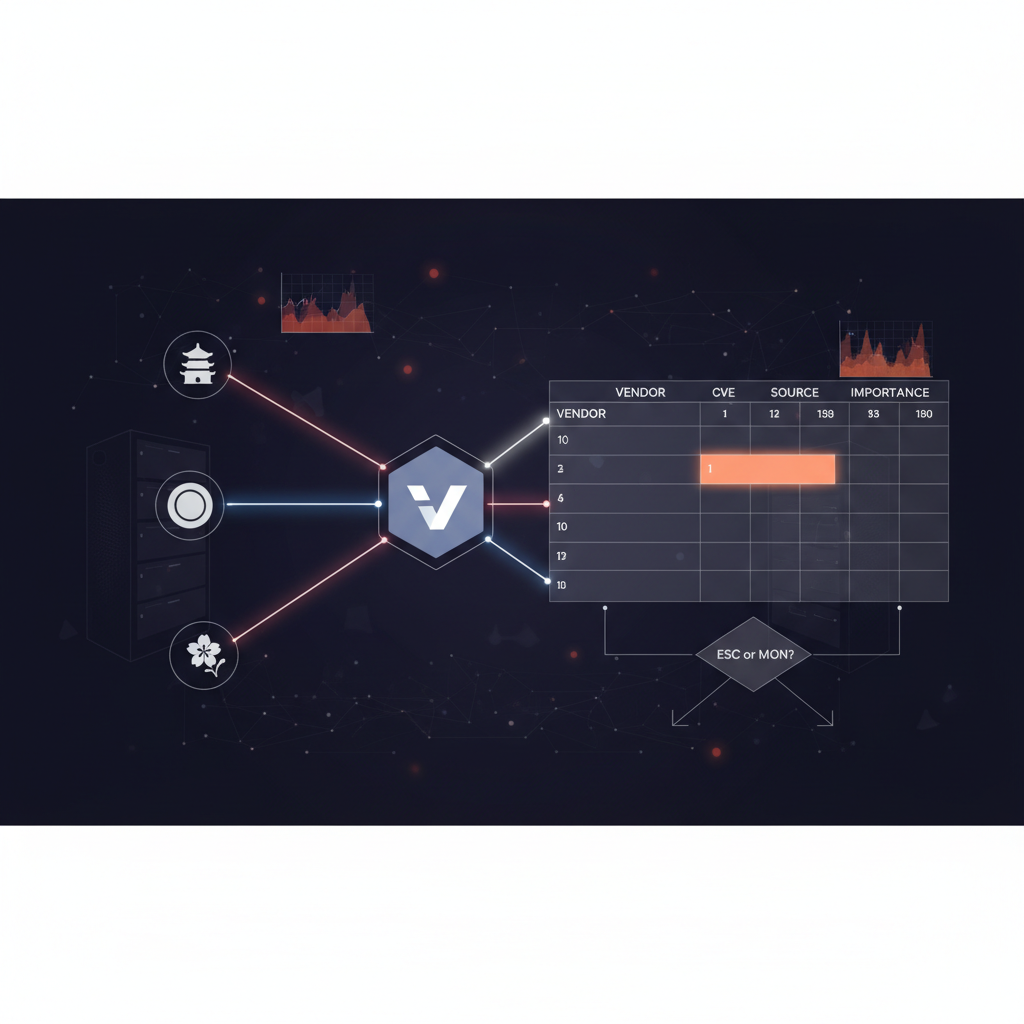
Executive Summary: This guide provides a step-by-step workflow for security teams to build and maintain a vendor exposure map using Nogosee’s East Asia Cyber & AI Risk Tracker as a monitoring layer. It covers essential fields to track, duplicate handling, escalation triggers, and monitoring practices without implying numeric thresholds or rigid rules. Designed for repeatable use by security, cloud, and supplier-risk teams.
Why It Matters
Building a vendor exposure map from East Asia CERT feeds begins with defining the scope of vendors to track. Focus on third-party suppliers, cloud providers, and technology partners that appear in public records from Taiwan’s TWCERT/CC, Japan’s JPCERT/CC or JVN, and Korea’s KrCERT/KISA. Use Nogosee’s tracker as a monitoring layer to collect and normalize these signals into structured records with entities, sectors, tags, and importance levels. The map should include core fields such as vendor name, associated CVE or incident ID, signal source (e.g., TWCERT/CC), date observed, event type (e.g., vulnerability, incident), importance rating, and a link to the original public record. These fields enable consistent filtering, sorting, and correlation across teams.
Handling duplicates is essential to maintain signal clarity. When the same vendor appears in multiple signals—such as a CVE advisory and a subsequent incident statement—compare the dates, sources, and importance levels. Retain the signal with the highest importance or most recent date as the primary entry, and link the others as supporting context. This avoids overcounting while preserving the ability to trace the evolution of a vendor’s risk profile. Do not merge signals automatically; instead, apply manual review to ensure context is not lost, especially when signals differ in sector, event type, or geographic focus.
Technical Signal
Escalation decisions should be guided by patterns rather than fixed thresholds. Consider escalating a vendor’s status if it appears in multiple high-importance signals across different event types (e.g., both a vulnerability and a confirmed breach), if it is linked to critical infrastructure sectors such as energy or finance, or if related signals emerge in close temporal proximity. However, avoid rigid rules like 'escalate after two signals.' Instead, use language such as 'consider escalation when patterns suggest increasing exposure' and involve risk owners in joint review. For vendors with only low- or medium-importance isolated signals, maintain them in monitor-only status and re-check when new signals appear in the same region, sector, or threat theme such as ransomware or supply chain.
Ownership of the exposure map should reside with supplier-risk or third-party security management teams, who are responsible for updating the map, assigning review cadences, and communicating findings to procurement and cloud teams. SOC and threat intelligence teams should contribute context on exploitability and observed TTPs, while cloud security teams can map vendors to actual service integrations. Updates should be triggered not by time-based schedules alone, but by the appearance of new signals in the tracker—particularly those marked as high importance or related to active monitoring queues.
Operational Impact
Finally, teams must treat Nogosee as a discovery and normalization tool, not a source of truth. Always open the original source link provided in the signal record to verify details, check for updates or retractions, and assess the credibility and timeliness of the publishing CERT. Use the tracker’s 'Inspect Signals' step to compare nearby records—for example, checking if other vendors in the same sector were affected—and consult the 'Methodology' section to understand update cadences and coverage limits. This approach ensures the vendor exposure map remains a practical, source-grounded tool for proactive risk monitoring in East Asia-facing supply chains.
Treat the official source as a monitoring input, not as proof that every feed entry deserves a public article. The practical value is a repeatable triage layer: capture the source title, original URL, visible publication date, affected product or service when available, and the operational surface involved. When those fields are thin or ambiguous, the item should stay in the tracker as monitoring data rather than becoming a standalone post.
What To Watch
For readers watching Taiwan, the escalation question is whether the notice touches a real local, national, regional, sector, or operating dependency. Supplier exposure, cloud identity, telecom, financial services, government systems, semiconductor or manufacturing links, public-sector technology, managed service providers, and internet-facing infrastructure are strong signals even before global media frames them as cross-border events.
A healthy workflow separates three outcomes. Routine items become searchable tracker records. Items with clear patch urgency, exploitation language, named affected technology, or cross-border supplier relevance become article candidates. Items that are old, duplicated, underspecified, or mostly vendor boilerplate should remain monitor-only even if they contain familiar cybersecurity keywords.
Event Type: security
Importance: medium
Affected Sectors
- cloud
- governance
- security
- supplier-risk
Frequently Asked Questions
What is the purpose of a vendor exposure map built from East Asia CERT feeds?
A vendor exposure map helps security and supplier-risk teams track which third-party vendors appear in public cybersecurity signals from Taiwan, Japan, and Korea CERTs, enabling proactive monitoring of supply chain risk without relying solely on direct breach notifications.
How should duplicates be handled when building a vendor exposure map from CERT feeds?
Duplicates should be identified by matching vendor names, CVEs, and incident dates across signals. When duplicates are found, retain the most recent or highest-importance signal and link others as context to avoid redundancy while preserving traceability.
What triggers escalation versus monitor-only status for a vendor in the exposure map?
Escalation should be considered when a vendor appears in multiple high-importance signals, shows a pattern of repeated incidents, or is linked to critical infrastructure sectors. Otherwise, retain the vendor in monitor-only status with periodic re-checks when related signals emerge.
Who should own and maintain the vendor exposure map in an organization?
Supplier-risk or third-party security teams should own the map, with input from cloud and SOC teams for context. Updates should be coordinated during regular risk reviews, using the tracker as a source of early signals rather than a system of record.
How can teams use Nogosee’s tracker as part of this workflow without treating it as a definitive source?
Teams should use Nogosee to discover and structure public signals from East Asia CERTs, then verify findings by opening the original source links, checking update cadences, and comparing nearby records before making operational decisions.