Answer Brief
Create a practical vendor risk watchlist by leveraging Nogosee’s East Asia Cyber & AI Risk Tracker to monitor public signals from Taiwan, Japan, Korea, China, Singapore, Philippines, and Thailand. Focus on structured signal review, ownership assignment, and flexible escalation based on operational relevance.
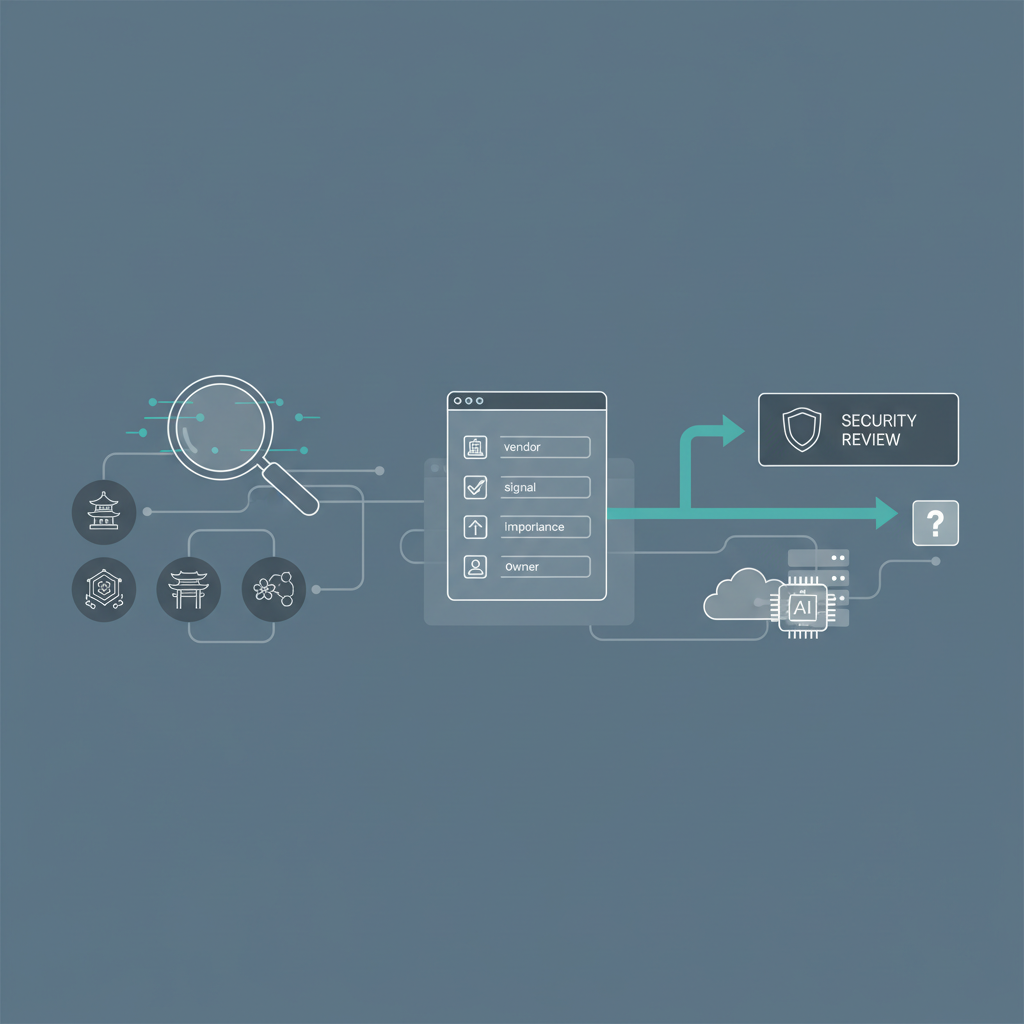
Executive Summary: Create a practical vendor risk watchlist by leveraging Nogosee’s East Asia Cyber & AI Risk Tracker to monitor public signals from Taiwan, Japan, Korea, China, Singapore, Philippines, and Thailand. Focus on structured signal review, ownership assignment, and flexible escalation based on operational relevance.
Why It Matters
Building a lightweight vendor risk watchlist for East Asia begins with identifying reliable public sources that publish cyber, AI, cloud, and infrastructure security signals. Nogosee’s tracker normalizes inputs from government CERTs, procurement databases, and disclosure platforms across Taiwan, Japan, Korea, China, Singapore, Philippines, and Thailand into structured records with consistent fields: event type, sector, tag, importance, timeline, and source link. This standardization allows teams to compare signals across borders and languages without manual translation or format reconciliation. The first step is to define your scope—select the regions and sectors most relevant to your vendor ecosystem, such as cloud providers in Singapore or semiconductor suppliers in Taiwan—and save that query as a baseline view in the tracker.
Ownership should be clearly assigned to an individual or team responsible for vendor risk management, third-party security, or supply chain resilience. This owner does not need to be a regional expert but must understand how to interpret signal metadata and coordinate with local analysts when language or context poses a barrier. Their primary duty is to monitor the saved query for new entries, assess whether each signal warrants deeper review based on vendor name, affected product, or service impact, and log findings in a shared register. The tracker supports this workflow by offering RSS alerts, CSV exports, and saved query links that can be integrated into existing ticketing or GRC systems.
Technical Signal
Review cadence should be recurring but flexible—tied to sprint cycles, risk committee meetings, or change management windows—rather than fixed intervals like ‘daily’ or ‘every 72 hours.’ The source context explicitly discourages hard numeric thresholds, so teams should instead use qualitative triggers: for example, reviewing when five or more new signals appear, when a high-importance tag emerges, or when a vendor appears across multiple regional feeds. This approach respects the variable velocity of public source updates while maintaining vigilance.
Escalation criteria must be risk-based, not procedural. A signal should be escalated if it reveals a zero-day exploit in a vendor’s software, a supply chain compromise involving East Asia-based logistics, or a government-enforced restriction on a cloud service used in your operations. The tracker’s importance field—ranked by freshness, source signal strength, and operational relevance—can inform this decision, but final judgment rests with the owning team’s risk appetite and exposure profile. Avoid rigid rules like ‘escalate all high-importance signals’; instead, use the tracker as a starting point for analyst-led triage.
Operational Impact
Next actions include saving the watchlist query, setting up RSS or email alerts for changes, exporting data monthly for audit trails, and conducting quarterly reviews of the watchlist’s effectiveness—such as tracking how many signals led to patches, vendor engagements, or architecture changes. Crucially, treat the watchlist as a living tool: remove sources that consistently yield low-value noise, add new ones as regional CERTs improve their reporting, and adjust filters as your vendor footprint evolves. By grounding the process in Nogosee’s public tracker, teams gain a repeatable, source-grounded method to turn regional signals into actionable vendor risk intelligence without over-reliance on proprietary feeds or speculative analysis.
Treat the official source as a monitoring input, not as proof that every feed entry deserves a public article. The practical value is a repeatable triage layer: capture the source title, original URL, visible publication date, affected product or service when available, and the operational surface involved. When those fields are thin or ambiguous, the item should stay in the tracker as monitoring data rather than becoming a standalone post.
What To Watch
For readers watching East Asia, the escalation question is whether the notice touches a real local, national, regional, sector, or operating dependency. Supplier exposure, cloud identity, telecom, financial services, government systems, semiconductor or manufacturing links, public-sector technology, managed service providers, and internet-facing infrastructure are strong signals even before global media frames them as cross-border events.
A healthy workflow separates three outcomes. Routine items become searchable tracker records. Items with clear patch urgency, exploitation language, named affected technology, or cross-border supplier relevance become article candidates. Items that are old, duplicated, underspecified, or mostly vendor boilerplate should remain monitor-only even if they contain familiar cybersecurity keywords.
Event Type: security
Importance: medium
Affected Sectors
- AI risk
- cloud infrastructure
- cybersecurity
- government operations
Frequently Asked Questions
What sources should I include in an East Asia vendor risk watchlist?
Include public records from Taiwan’s MOPS and government cybersecurity procurement, Japan’s JPCERT/CC and JVN, Korea’s KrCERT/KISA advisories, China’s CNCERT/CC and industry disclosures, Singapore’s CSA/SingCERT, Philippines’ NCERT, and Thailand’s ThaiCERT updates. Prioritize sources with structured, machine-readable feeds or searchable databases.
How often should I review the vendor risk watchlist?
Review the watchlist on a recurring basis aligned with your team’s operational rhythm—such as weekly or biweekly—without fixed deadlines. Use Nogosee’s tracker to monitor for new signals, then assess relevance based on vendor exposure, signal importance, and regional context before deciding on deeper review or escalation.
Who should own and maintain the vendor risk watchlist?
Assign ownership to a cross-functional team member in vendor risk, third-party security, or cloud operations who understands East Asia regulatory and threat landscapes. This owner should coordinate with regional specialists or threat intelligence analysts to validate signals and determine when to escalate for further investigation.
When should I escalate a signal from the watchlist?
Escalate when a signal indicates active exploitation, unpatched critical vulnerability in a vendor’s product, or confirmed breach affecting services you use—especially if tied to East Asia-based infrastructure or supply chains. Use Nogosee’s importance and freshness metrics as guidance, but apply organizational risk thresholds.
How do I avoid noise when building a public-source watchlist?
Focus on structured signals with clear entities, sectors, tags, and source links. Use Nogosee’s filtering by region, event type, and importance to reduce noise. Treat low-value items as monitoring records rather than immediate actions, and rely on the tracker’s methodology to normalize and enrich public data before review.