Answer Brief
OpenAI confirmed two employees' devices were breached in the TanStack supply chain attack, leading to credential exposure and precautionary code-signing certificate rotation, with no impact to customer data or production systems.
Signal Timeline
A quick visual path for analysts before reading the full brief.
- 1
OpenAI publishes security advisory confirming breach
- 2
Deadline for macOS users to update OpenAI desktop apps due to certificate rotation
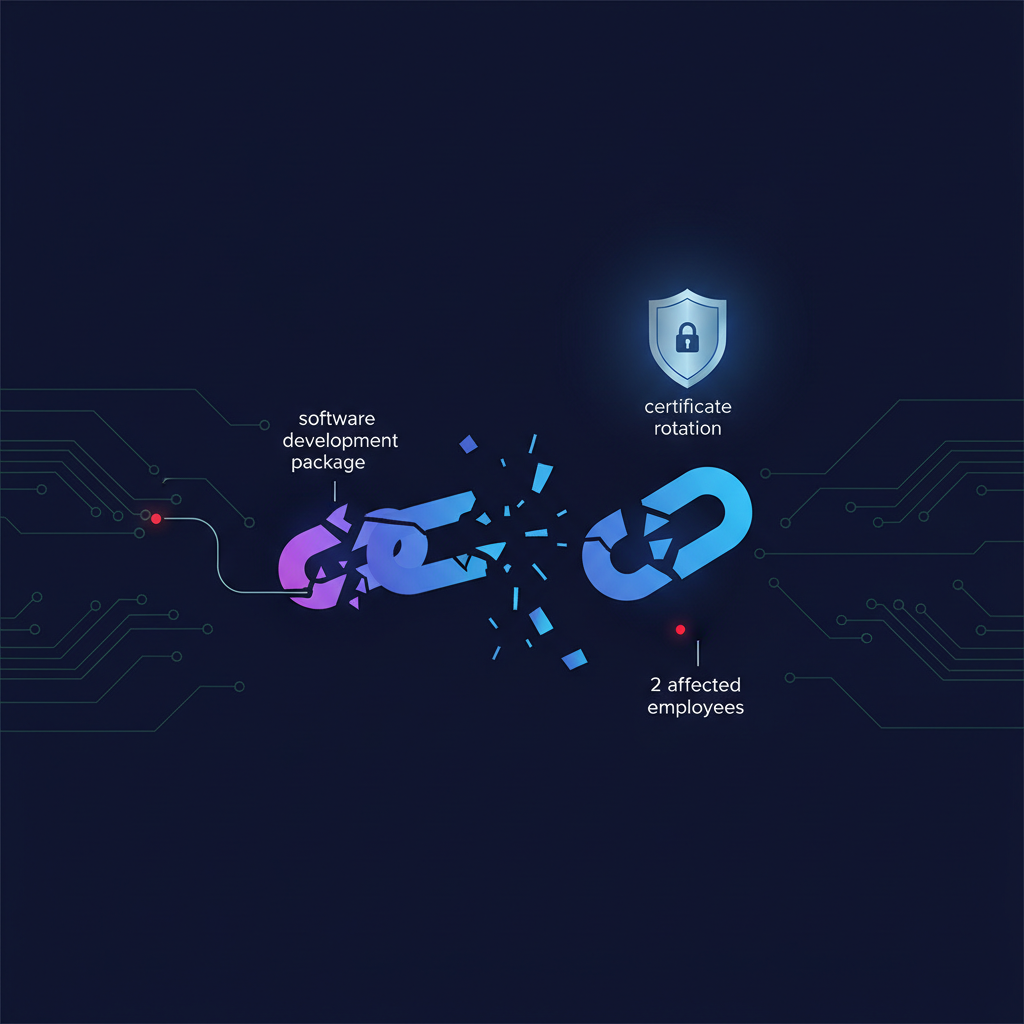
Executive Summary: OpenAI confirmed two employees' devices were breached in the TanStack supply chain attack, leading to credential exposure and precautionary code-signing certificate rotation, with no impact to customer data or production systems.
Why It Matters
OpenAI's confirmation of a breach stemming from the TanStack supply chain attack highlights the persistent risk posed by trusted open-source ecosystems to even the most security-mature organizations. The incident began with attackers compromising TanStack's CI/CD infrastructure via weaknesses in GitHub Actions workflows, enabling them to steal credentials and inject malicious code into package releases. This allowed the distribution of trojanized versions of popular npm and PyPI packages under the guise of legitimate updates—a technique central to the 'Mini Shai-Hulud' campaign attributed to the TeamPCP extortion gang. The attack's scope expanded rapidly, impacting hundreds of packages across projects like Mistral AI, UiPath, Guardrails AI, and OpenSearch, demonstrating how a single upstream vulnerability can cascade through interconnected software supply chains. For OpenAI, the breach was limited to two employee devices, resulting in unauthorized access to internal source code repositories and the exfiltration of limited credentials. While the company found no evidence that stolen credentials were used in further attacks or that exposed code-signing certificates were abused to sign malicious software, it opted for a full rotation of certificates used across macOS, Windows, iOS, and Android platforms as a precautionary measure. This decision underscores a security best practice: assuming potential compromise in credential exposure scenarios and acting preemptively to mitigate downstream risks, especially when code-signing infrastructure is involved. The operational impact is narrowly focused but significant for end-users. macOS users of OpenAI desktop applications must update their software by June 12, 2026, to maintain functionality, as Apple's notarization process will block apps signed with the pre-rotation certificates. Windows and iOS users face no disruption, reflecting platform-specific differences in how code signing and trust validation are enforced. OpenAI’s transparent disclosure, including engagement with a third-party incident response firm and forensic analysis, aligns with mature incident handling practices, though it also raises questions about detection latency and the scope of internal monitoring for credential misuse. This incident reinforces a growing trend identified by OpenAI: attackers are increasingly targeting software supply chains not to breach specific organizations directly, but to achieve broad, indirect impact by exploiting the trust placed in open-source dependencies and automated build pipelines. The theft of developer and cloud credentials—including GitHub tokens, npm publish tokens, AWS secrets, and SSH keys—enables lateral movement and persistence, as seen in the malware’s use of modified Claude Code hooks and VS Code auto-run tasks to survive removal. The inclusion of a destructive component targeting Israeli or Iranian systems further illustrates the dual-use nature of such malware, combining espionage with sabotage. For global security, AI, cloud, and DevOps teams, the OpenAI case serves as a critical reminder that supply chain risk extends beyond vulnerability scanning to include behavioral monitoring of CI/CD environments, credential hygiene in developer workflows, and validation of release pipeline integrity. Organizations should monitor for anomalous package publishes, unexpected changes in build scripts, and signs of credential theft in developer environments. The event also validates the importance of code-signing certificate rotation as a precautionary control, even in the absence of confirmed abuse, particularly when tied to widely distributed applications subject to platform enforcement mechanisms like Apple’s notarization.
Event Type: security
Importance: high
Affected Companies
- OpenAI
- TanStack
- TeamPCP
Affected Sectors
- AI
- Cybersecurity
- Software Development
Key Numbers
- Employees affected: 2
- Certificate rotation deadline for macOS users: June 12, 2026
- Packages impacted in supply chain attack: hundreds
Timeline
- OpenAI publishes security advisory confirming breach
- Deadline for macOS users to update OpenAI desktop apps due to certificate rotation
Frequently Asked Questions
What was the impact of the TanStack supply chain attack on OpenAI?
Two OpenAI employees had their devices breached, leading to unauthorized access to internal source code repositories and theft of limited credentials. Code-signing certificates for macOS, Windows, iOS, and Android were exposed, prompting a precautionary rotation. No customer data, production systems, IP, or deployed software were impacted.
Why is OpenAI rotating its code-signing certificates?
OpenAI is rotating code-signing certificates as a precaution after they were exposed in the breach, even though no abuse has been detected. macOS users must update OpenAI desktop apps by June 12, 2026, to avoid launch or update failures due to Apple's notarization process; Windows and iOS users are unaffected.
How did the TanStack supply chain attack compromise software packages?
Attackers exploited weaknesses in TanStack's GitHub Actions workflows and CI/CD configuration to steal credentials, extract tokens from memory, and publish malicious package versions through legitimate release pipelines, making trojanized packages appear authentic in npm and PyPI repositories.
What is the 'Mini Shai-Hulud' campaign and who is behind it?
The 'Mini Shai-Hulud' campaign is a software supply chain attack attributed to the TeamPCP extortion gang that targeted hundreds of npm and PyPI packages by compromising developer credentials and CI/CD pipelines to distribute trojanized packages. It focused on stealing developer and cloud credentials, establishing persistence via modified developer tool hooks, and included a destructive component targeting some Israeli or Iranian systems.
What steps should organizations take to defend against similar supply chain attacks?
Organizations should monitor for anomalous package publishes, unexpected changes in build scripts, and signs of credential theft in developer environments. They should validate release pipeline integrity, enforce credential hygiene in CI/CD workflows, monitor for misuse of exposed credentials, and treat code-signing certificate rotation as a precautionary control when exposure occurs, especially for applications subject to platform enforcement like Apple's notarization.