Answer Brief
This practical checklist guides security teams on using Nogosee’s public-signal scoring workflow to decide whether an East Asia cyber or AI signal should become an article, remain a tracker record, or be held for later review. It outlines decision criteria, ownership, escalation paths, and next steps without implying rigid thresholds or publishing cadences.
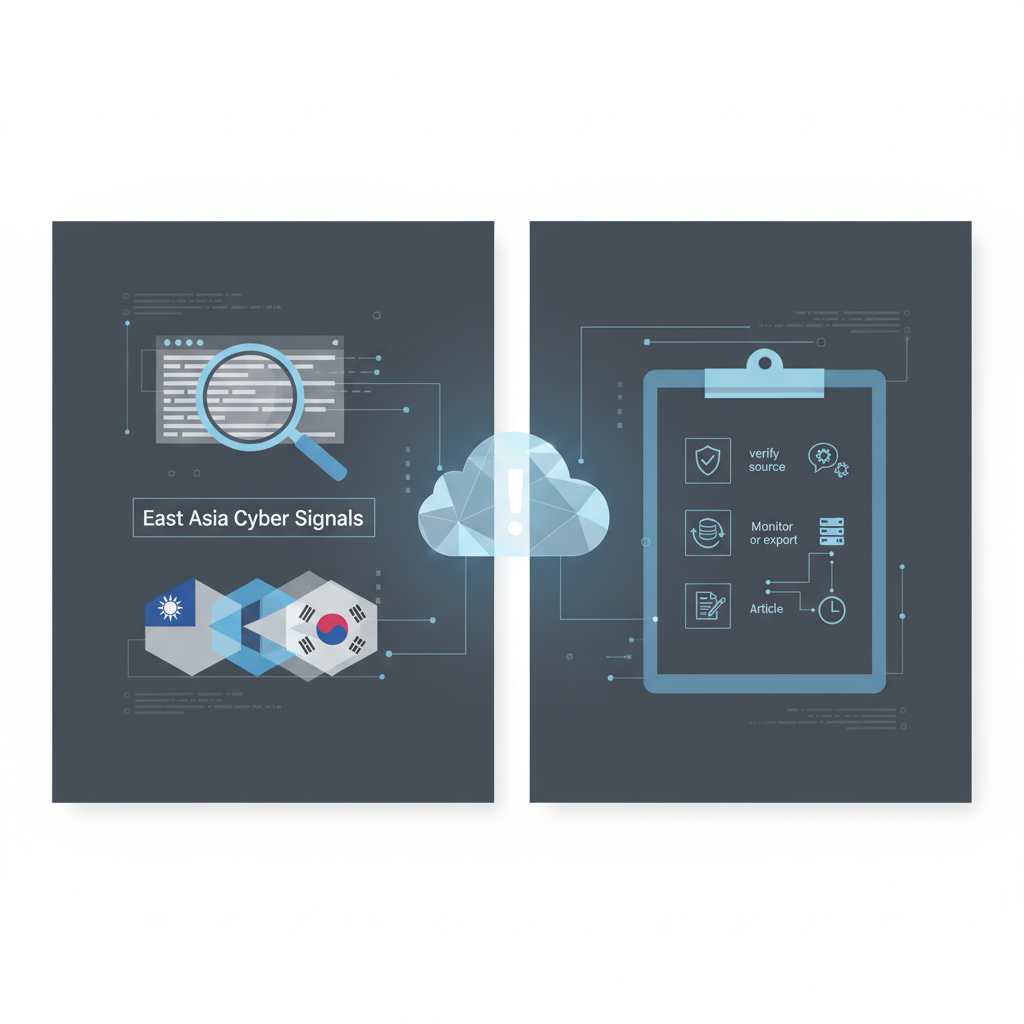
Executive Summary: This practical checklist guides security teams on using Nogosee’s public-signal scoring workflow to decide whether an East Asia cyber or AI signal should become an article, remain a tracker record, or be held for later review. It outlines decision criteria, ownership, escalation paths, and next steps without implying rigid thresholds or publishing cadences.
Why It Matters
Nogosee’s public-signal scoring workflow begins with searching the tracker using specific identifiers such as country, CVE, company, sector, or threat themes like ransomware or AI security. Teams are advised to start with a focused query to isolate relevant records before broadening context. This first step ensures efficiency when monitoring high-volume feeds from sources like JVN, KrCERT, or government procurement disclosures across Taiwan, Japan, Korea, and selected watchlist regions.
The second step involves inspecting signals by opening source-linked records, comparing priority levels, checking publication dates, and using related collection pages when a record needs additional context. This stage emphasizes verification: teams should treat Nogosee as a monitoring layer, not a primary source, and always consult the original publisher’s advisory, statement, or feed before drawing operational conclusions. Comparing nearby signals in the same region or sector helps assess whether an item is isolated or part of a broader trend.
Technical Signal
If a signal warrants deeper review but not immediate publication, teams can export or monitor it using capped CSV, indicator CSV, RSS feeds, or copyable briefs for repeat workflow use. Larger data access requires a formal request, and private query logic remains unpublished. This allows teams to maintain internal watchlists or integrate Nogosee data into SIEM, TIP, or GRC tools without overloading the public interface.
The workflow clarifies who benefits: security, cloud, governance, supplier-risk, and research teams that need English-language access to East Asia public cyber, AI, cloud, incident, procurement, and CERT signals. These groups rely on the tracker to bridge language and access gaps, especially when dealing with regional CERTs, MOPS disclosures, or procurement tenders that may not be widely reported internationally.
Operational Impact
Verification is a core principle: teams must open the linked source, compare nearby tracker records, and check methodology and update cadence before making operational decisions. Nogosee does not replace original advisories but enriches them with structured metadata—entities, sectors, tags, event type, importance, and timelines—to accelerate triage. This reduces noise while preserving traceability to authoritative sources like Foxconn’s incident statements or Weikang Technology’s breach disclosures.
Public access to the tracker is intentionally capped: search, CSV, RSS, and topic pages provide samples, while full feeds, historical exports, and custom monitoring are request-only. This design balances openness with resource management, ensuring that deep dives are reserved for signals that pass initial scoring. Teams should not assume that low visibility in the public interface means low value; instead, they should use the request form when sustained monitoring or historical analysis is needed.
What To Watch
The tracker’s snapshot shows a strong regional focus: 610 records from Taiwan, 56 from Japan, 13 from Korea, and 26 from the Thailand watchlist, with event types dominated by Security (705) and Vulnerability (56). Sources include public records, vulnerability feeds, and security notice feeds, all normalized into English when necessary. The latest visible signal at the time of checking was a statement on cyberattacks affecting group sites in North America, linked to Hon Hai / Foxconn.
Finally, the triage matrix provides concrete guidance: signals like the Foxconn, Weikang, and Chang Yuan incidents were advised to be kept in monitoring and re-checked when related signals appear in the same region or sector. This reflects a cautious, pattern-aware approach—avoiding premature publication while maintaining readiness to escalate if corroborating evidence emerges. The checklist rejects rigid thresholds in favor of flexible, context-driven judgment, aligning with Nogosee’s role as a first-hand signal tracker rather than a news wire.
Treat the official source as a monitoring input, not as proof that every feed entry deserves a public article. The practical value is a repeatable triage layer: capture the source title, original URL, visible publication date, affected product or service when available, and the operational surface involved. When those fields are thin or ambiguous, the item should stay in the tracker as monitoring data rather than becoming a standalone post.
For readers watching East Asia, the escalation question is whether the notice touches a real local, national, regional, sector, or operating dependency. Supplier exposure, cloud identity, telecom, financial services, government systems, semiconductor or manufacturing links, public-sector technology, managed service providers, and internet-facing infrastructure are strong signals even before global media frames them as cross-border events.
Event Type: security
Importance: medium
Affected Sectors
- cloud
- governance
- research
- security
- supplier-risk
Frequently Asked Questions
What is the purpose of scoring East Asia public signals in Nogosee’s workflow?
Scoring helps determine whether a signal from the tracker should be developed into a full article, kept as a monitoring record, or deferred for a weekly brief. It ensures only high-signal, well-contextualized items become public intelligence briefs while preserving lower-priority data for source verification and trend analysis.
Who should apply this scoring checklist when reviewing Nogosee signals?
Security, cloud, governance, supplier-risk, and research teams using Nogosee for East Asia cyber and AI risk monitoring should apply this checklist. It supports consistent editorial gating across teams that rely on the tracker for operational decisions, watchlist updates, or incident preparedness.
What should teams do if a signal lacks sufficient context or source verification?
Teams should keep the signal in monitoring and re-check when related signals appear in the same region or sector. They should open the linked source, compare nearby tracker records, and assess methodology and update cadence before deciding whether to escalate or develop the signal further.
When should a signal be considered for a weekly brief instead of an immediate article?
A signal may be held for a weekly brief if it shows emerging patterns but lacks immediate operational impact, full source confirmation, or cross-sector relevance. The checklist supports flexible timing based on signal maturity, not fixed deadlines or publication schedules.
How does Nogosee define a signal worthy of becoming a public article?
A signal becomes a public article when it demonstrates sufficient freshness, importance, source signal strength, and operational relevance after verification. It must pass quality checks and offer clear value to global readers monitoring East Asia cyber, AI, cloud, or infrastructure risks.