Answer Brief
A research paper from Singapore Management University and GovTech Singapore details TitanCA, an LLM-based vulnerability discovery system that identified 203 zero-day flaws and generated 118 CVEs in open-source software through a four-agent architecture.
Signal Timeline
A quick visual path for analysts before reading the full brief.
- 1
Paper submitted to arXiv
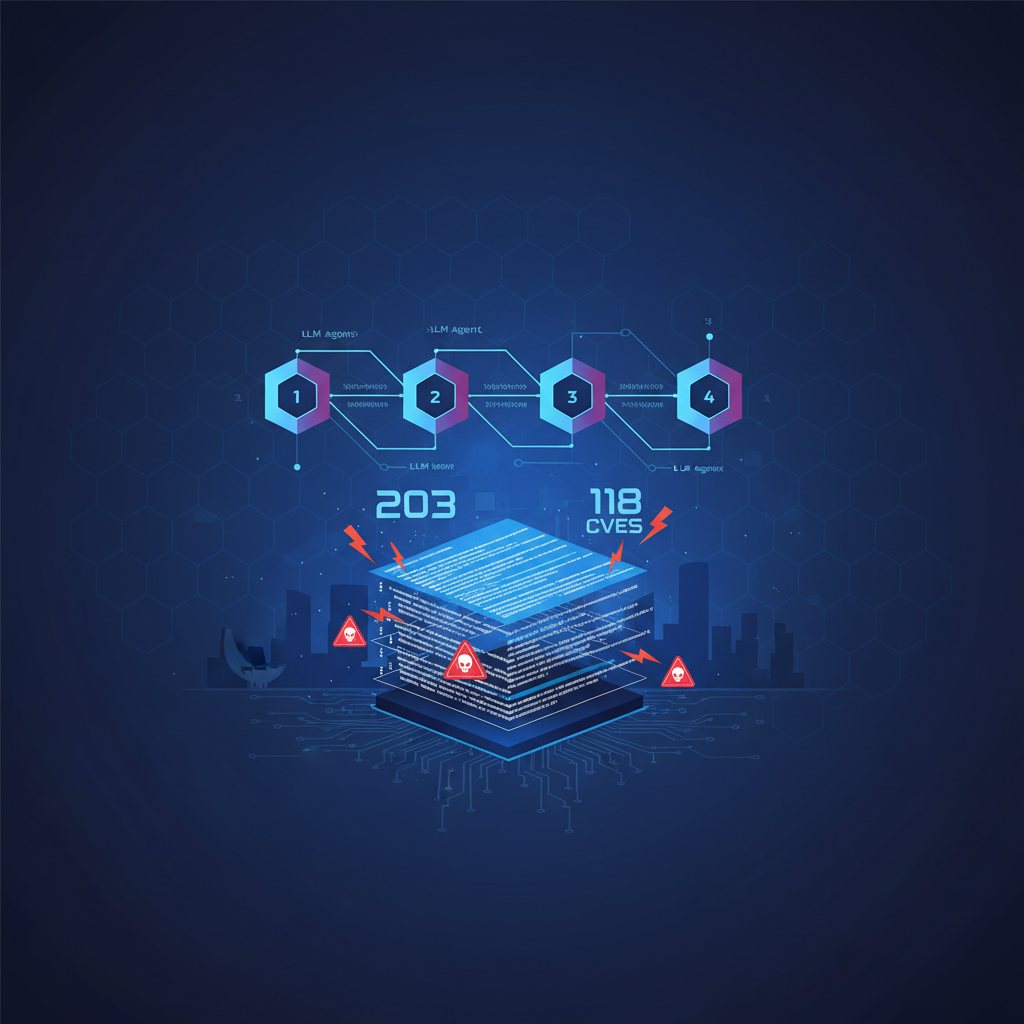
Executive Summary: A research paper from Singapore Management University and GovTech Singapore details TitanCA, an LLM-based vulnerability discovery system that identified 203 zero-day flaws and generated 118 CVEs in open-source software through a four-agent architecture.
Why It Matters
The TitanCA research presents a significant advancement in applying large language models to proactive vulnerability discovery, moving beyond traditional static application security testing (SAST) tools that are hampered by high false-positive rates. By orchestrating multiple LLM-powered agents through a structured four-module pipeline—matching, filtering, inspection, and adaptation—the system demonstrates how AI can be effectively harnessed to identify security flaws in complex software codebases. The discovery of 203 confirmed zero-day vulnerabilities, resulting in 118 assigned CVEs, underscores the system's efficacy in real-world open-source software environments. This output highlights the potential of LLM orchestration to augment human-led security efforts, particularly in scanning large volumes of code where manual review is impractical.
From an East Asia cybersecurity intelligence perspective, the work conducted by Singapore Management University and GovTech Singapore represents a high-signal development in regional AI-driven security innovation. Singapore has positioned itself as a hub for cybersecurity research and public-sector technology advancement, and this project exemplifies how academic-government collaboration can yield practical tools for vulnerability mitigation. The focus on open-source software is especially relevant given the widespread use of such components in global digital infrastructure, including cloud services, enterprise systems, and critical applications. Vulnerabilities in these dependencies can have cascading effects, making early discovery a strategic priority for defenders worldwide.
Technical Signal
The technical approach described in the paper offers actionable insights for security operations teams exploring AI integration into their vulnerability management workflows. Rather than relying on single-model prompts, TitanCA uses agent orchestration to divide labor—such as one agent matching code patterns, another filtering noise, a third inspecting context for exploitability, and a fourth adapting based on feedback. This modular design improves precision and reduces the alert fatigue common with conventional SAST tools. Teams in finance, healthcare, and technology sectors operating in or with East Asia should monitor similar LLM-based initiatives for potential adoption in code security pipelines.
However, the research also implies important boundaries and uncertainties. While the paper confirms the discovery and CVE assignment of vulnerabilities, it does not disclose which specific projects were scanned, the severity distribution of the flaws, or whether any were actively exploited prior to disclosure. The absence of exploit evidence or patch timelines means the immediate risk reduction impact cannot be quantified from the source alone. Additionally, the false-positive rate of TitanCA post-filtering is not detailed, leaving open questions about operational overhead in real deployment. Readers should treat the 118 CVEs as a signal of research success rather than a measure of deployed protection.
Operational Impact
Looking ahead, global security teams should watch for follow-up work from the TitanCA team regarding false-positive reduction metrics, integration with developer workflows (e.g., CI/CD pipelines), and expansion into proprietary or closed-source software analysis. There is also value in monitoring whether similar LLM orchestration models emerge from other East Asia institutions, particularly in Japan, South Korea, or Taiwan, as part of broader national AI security strategies. The TitanCA model may serve as a reference for balancing automation with analyst oversight in next-generation vulnerability discovery systems.
The important editorial point is that this is a Singapore threat-landscape signal, not a claim that the same campaign has already become a global incident. the regional source is useful because it shows what local researchers are seeing in their own operating environment. English-language readers should treat that as first-hand regional situational awareness for local operations, subsidiaries, suppliers, managed service providers, partners, and strategic monitoring rather than as a universal incident alert.
What To Watch
For monitoring teams, the first task is to preserve the source boundaries. The source item is titled "TitanCA: Lessons from Orchestrating LLM Agents to Discover 100+ CVEs", so the article should keep the report's local scope clear while translating the tactics, tooling, affected surfaces, and observed pattern into English. That makes the item useful without overstating victim geography or implying broader impact that the source did not document.
The practical value comes from comparison against internal telemetry. Teams with exposure in Singapore can check whether help-desk tickets, endpoint alerts, mail gateway detections, identity anomalies, blocked downloads, command-line activity, scheduled tasks, or suspicious script execution resemble the behaviors described by the source. A match does not prove attribution, but it can justify deeper triage.
This kind of regional report also helps separate durable monitoring themes from one-off news. If similar malware families, delivery chains, file types, infrastructure choices, or attacker workflows appear across later Singapore sources, the signal becomes stronger. Nogosee should keep those links visible in the tracker so readers can see whether a local report remains isolated or becomes part of a broader pattern.
For cybersecurity, artificial intelligence, software development, the safest next step is not to treat the article as incident-response advice. The useful action is to verify whether the organization has local exposure, identify which logs would show similar behavior, confirm that official source links are retained, and decide whether the report belongs in a watchlist, a detection backlog, or an executive regional-risk brief.
The uncertainty boundary should stay explicit. Public reports often describe observed techniques and malware names without proving every victim profile, infrastructure owner, or campaign objective. When the source does not establish those facts, the article should avoid filling the gap. That restraint is what makes the brief more useful than a generic rewrite: it gives readers a trustworthy map of what is known, what is merely plausible, and what needs direct verification.
Event Type: security
Importance: medium
Affected Companies
- GovTech Singapore
- Singapore Management University
Affected Sectors
- artificial intelligence
- cybersecurity
- software development
Key Numbers
- Confirmed zero-day vulnerabilities discovered: 203
- CVEs yielded from discoveries: 118
- Modules in TitanCA architecture: 4
Timeline
- Paper submitted to arXiv
Frequently Asked Questions
What is TitanCA and who developed it?
TitanCA is a vulnerability discovery system that orchestrates multiple large language model (LLM)-powered agents into a unified pipeline. It was developed collaboratively by Singapore Management University and GovTech Singapore.
How many zero-day vulnerabilities and CVEs did TitanCA discover?
TitanCA discovered 203 confirmed zero-day vulnerabilities in open-source software, which yielded 118 CVEs.
What are the four modules of the TitanCA architecture?
The TitanCA architecture consists of four modules: matching, filtering, inspection, and adaptation, which work together to orchestrate LLM agents for vulnerability discovery.