Answer Brief
Nogosee monitored 13 Taiwan listed-company cyber incident disclosures in April 2026. The cleaned month is incident-only: 13 incident records, 0 governance records, and 0 procurement records. This is a MOPS incident-disclosure snapshot for analyst workflow use, not a complete census of Taiwan cyber activity.
Signal Timeline
A quick visual path for analysts before reading the full brief.
- 1
建通 (2460) appears in the cleaned April incident-disclosure dataset.
- 2
豐達科 (3004) and 健喬 (4114) appear in the April MOPS incident-disclosure set.
- 3
Q Burger (7797) and 政美應用 (7853) appear as separate April incident-disclosure records.
- 4
HCT Logistics (2619) appears in the critical-infrastructure-transport grouping.
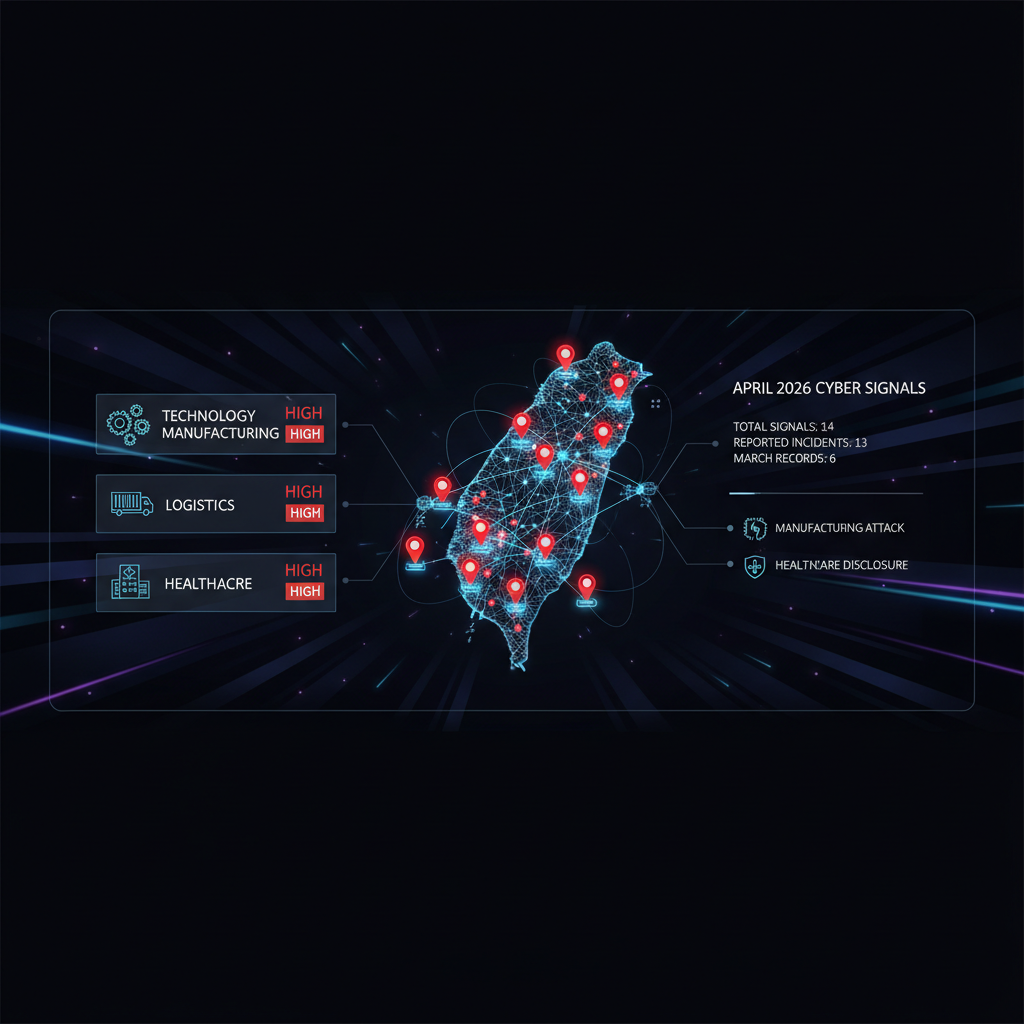
Executive Summary: Nogosee monitored 13 Taiwan listed-company cyber incident disclosures in April 2026. The cleaned month is incident-only: 13 incident records, 0 governance records, and 0 procurement records. This is a MOPS incident-disclosure snapshot for analyst workflow use, not a complete census of Taiwan cyber activity.
Why It Matters
April 2026 is now a cleaner and more useful Taiwan public-signal baseline. After filtering out low-signal assurance, verification, and personnel-style disclosures, the monitored April set contains 13 Taiwan MOPS cyber incident records. That narrower scope matters. A mixed pile of public filings can look busy while telling security teams very little. An incident-only view gives analysts a more defensible starting point for comparing named entities, sectors, and follow-up filings over time.
The first longitudinal comparison is March versus April. March 2026 contained 6 monitored Taiwan MOPS incident records in this dataset. April contains 13. The defensible interpretation is that Nogosee saw higher listed-company incident-disclosure volume in April than in the prior month. The dataset does not establish the cause of that increase. It does not prove a change in attacker behavior, reporting thresholds, regulation, incident severity, disclosure culture, or market-wide exposure. It only supports a narrower observation: the monitored public-disclosure layer produced more incident records in April than March.
Technical Signal
The trailing-window view adds more context. In the trailing 90-day window ending with April 2026, the database contains 21 incident records. April accounts for 13 of those visible incident records, which makes it the dominant month inside the current monitored window. For a security, cloud, or operations team, that is enough to justify keeping Taiwan listed-company disclosures in a near-term watchlist. It is not enough to claim that the named entities share an attacker, a vulnerability class, a service provider, or a common operational impact.
The horizontal distribution is also important. The April records are spread across five database sector groupings: public-sector-and-listed-company-risk has 6 records, technology-manufacturing has 3, government has 2, critical-infrastructure-transport has 1, and healthcare has 1. These are Nogosee database groupings for analyst filtering, not detailed business descriptions. The main takeaway is that the monitored disclosures were not confined to one visible category. They appeared across general listed-company risk, technology/manufacturing, government-facing, transport, and healthcare-adjacent surfaces.
Operational Impact
Entity concentration is modest. Most named entities appear once. 豐達科 (3004) appears twice because the database contains more than one April record for that entity. In an analyst workflow, repeated entity appearances call for source review rather than immediate narrative escalation. Multiple public records can reflect corrections, follow-up wording, separate disclosures, or source-format duplication. The right workflow is to preserve the public links, compare dates and wording, and keep the entity visible in the tracker until later records clarify whether the recurrence is operationally meaningful.
The named-entity layer is useful because it can be mapped against real exposure. HCT Logistics (2619) appears in the critical-infrastructure-transport grouping. 台寶生醫 (6892) appears in healthcare. 力致 (3483), 維熹 (3501), and 新代 (7750) appear in technology-manufacturing. 建通 (2460), 振樺電 (8114), 政美應用 (7853), Q Burger (7797), 弘塑 (3131), 健喬 (4114), and 豐達科 (3004) are also part of the April incident set. Those names are most valuable when compared with supplier lists, customer lists, regional operations, procurement exposure, or managed-service dependencies.
What To Watch
The source-family limitation is straightforward: this report is built from Taiwan MOPS material-information records. MOPS is valuable because it is a public listed-company disclosure channel, but it is not a forensic feed. A MOPS item can confirm that a public disclosure exists; it often does not provide attacker identity, root cause, data-loss scope, precise service downtime, remediation completeness, affected systems, or customer impact. Treating these records as public incident signals rather than full incident reports keeps the analysis honest and avoids turning sparse filings into invented threat narratives.
The operational value comes from turning filings into a repeatable triage workflow. A SOC analyst can start with the April entity list, match it against monitored vendors and counterparties, open the original MOPS records for source verification, and watch for later filings from the same entities. A cloud or operations team can use the sector grouping as a routing layer: transport-related names go to resilience and vendor-risk review, healthcare-related names go to data and compliance review, and technology/manufacturing names go to supplier and production-dependency review. None of that requires guessing the attacker or impact.
The report is also useful as a quality-control example for the database itself. Incident-focused monthly briefs become weaker when compliance, assurance, security-testing response, or personnel-change records are mixed into the same count. Those records can exist in public sources, but they are different signal classes. If they are included in an incident count, the reader may believe Taiwan had more cyber incident disclosures than the incident evidence supports. The cleaned April view therefore improves both editorial quality and tracker quality.
There are two practical ways to use this month. First, treat April as a watchlist seed: preserve the 13 incident records, keep the original source URLs, and revisit the same entities in May. Second, treat March's 6 records and the trailing 90-day count of 21 as comparison anchors. If May remains high, the tracker can start showing whether the concentration persists by sector or entity. If May falls back, April may look like a short-lived disclosure-heavy month inside the monitored dataset.
Several limits remain. This is not a national incident census. It does not cover private incidents without public disclosure, every Taiwan public-sector incident, every small or unlisted company, or incidents reported only through other channels. It also does not show whether any named companies are connected to one another. The strongest claim is deliberately narrower: April 2026 produced 13 monitored Taiwan MOPS cyber incident disclosures in Nogosee's cleaned public-signal database, compared with 6 monitored incident records in March and 21 incident records in the trailing 90-day window.
The next useful product step is comparison, not volume. A future May brief can compare count, source wording, sector mix, entity recurrence, and follow-up records against this cleaned April baseline. That is how the database becomes more valuable than a one-off article: each monthly report can become a reference point for trend review, exposure triage, and source-backed regional risk monitoring.
Event Type: security
Importance: high
Affected Companies
- HCT Logistics (2619)
- Q Burger (7797)
- 健喬 (4114)
- 力致 (3483)
- 台寶生醫 (6892)
- 建通 (2460)
- 弘塑 (3131)
- 振樺電 (8114)
- 政美應用 (7853)
- 新代 (7750)
- 維熹 (3501)
- 豐達科 (3004)
Affected Sectors
- critical-infrastructure-transport
- government
- healthcare
- public-sector-and-listed-company-risk
- technology-manufacturing
Key Numbers
- Cleaned April Incident Records: 13
- March Incident Baseline: 6
- April Governance Records: 0
- April Procurement Records: 0
- Trailing 90-Day Incident Records: 21
Timeline
- 建通 (2460) appears in the cleaned April incident-disclosure dataset.
- 豐達科 (3004) and 健喬 (4114) appear in the April MOPS incident-disclosure set.
- Q Burger (7797) and 政美應用 (7853) appear as separate April incident-disclosure records.
- HCT Logistics (2619) appears in the critical-infrastructure-transport grouping.
- 新代 (7750) appears near month-end in the technology-manufacturing grouping.
Frequently Asked Questions
What changed in this cleaned Taiwan April 2026 report?
The report now focuses only on the 13 April MOPS cyber incident disclosures in the cleaned dataset. Low-signal assurance, verification, and personnel-style records are outside this incident-focused count.
How many April 2026 incident disclosures remain after cleanup?
The cleaned April dataset contains 13 monitored Taiwan MOPS cyber incident disclosures. The current-month report scope contains 0 governance records and 0 procurement records.
Does the higher April count prove a cause?
No. April has more monitored incident records than March, but the dataset does not prove why. It does not establish attacker behavior, reporting culture, regulation, or incident severity.
How can security teams use this report?
Use it as a source-linked watchlist. Compare the named entities with supplier, customer, operational, and vendor-risk exposure, then revisit the original MOPS links for follow-up or correction filings.
Why is MOPS useful but limited?
MOPS can show that a listed company made a public disclosure, but it usually does not provide full forensic detail, root cause, attacker identity, data-loss scope, or remediation completeness.