Answer Brief
ARuleCon is an agentic AI framework that autonomously converts security rules across SIEM platforms (Splunk SPL, Microsoft KQL, IBM AQL, Google YARA-L, RSA ESA) without requiring manual logic distillation, validated through case studies with Singtel Singapore showing significant expert time savings.
Signal Timeline
A quick visual path for analysts before reading the full brief.
- 1
Paper submitted to arXiv
- 2
Paper accessed via arXiv
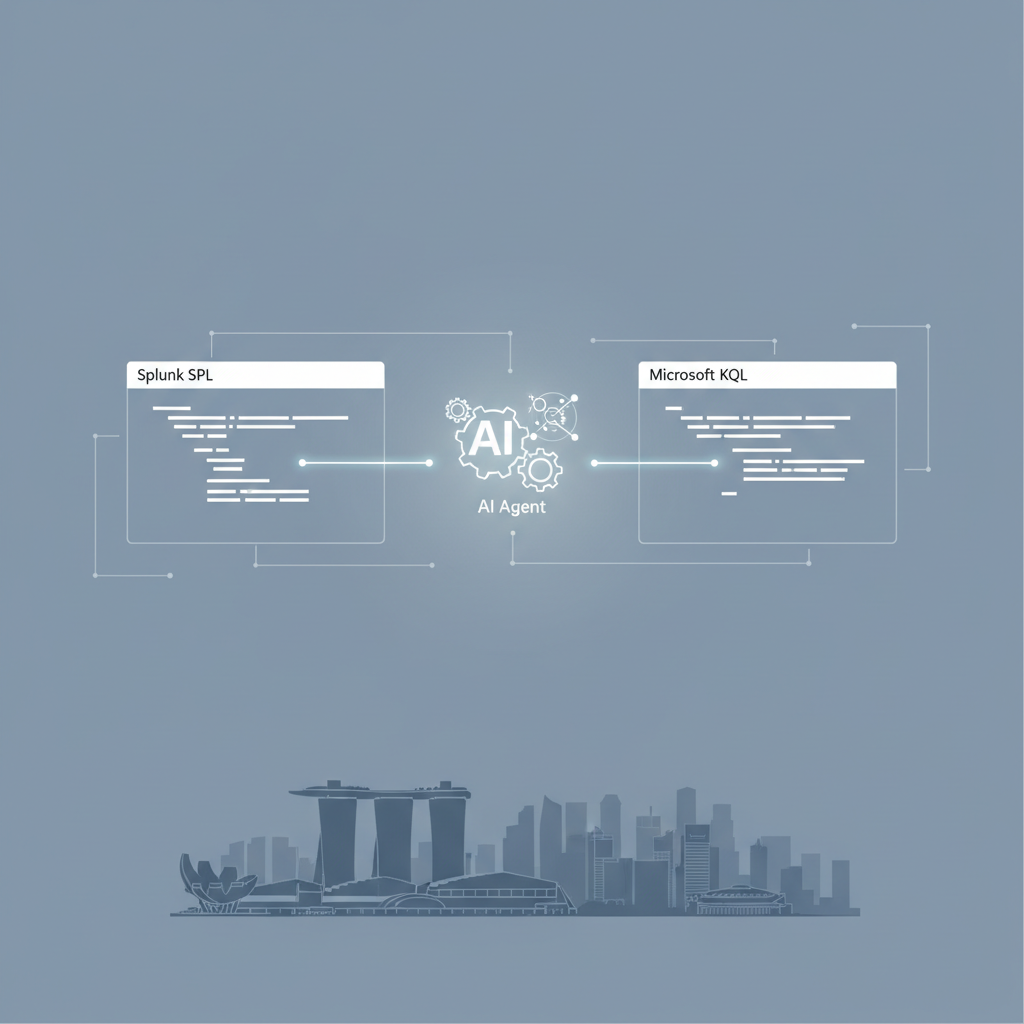
Executive Summary: ARuleCon is an agentic AI framework that autonomously converts security rules across SIEM platforms (Splunk SPL, Microsoft KQL, IBM AQL, Google YARA-L, RSA ESA) without requiring manual logic distillation, validated through case studies with Singtel Singapore showing significant expert time savings.
Why It Matters
ARuleCon addresses a persistent operational challenge in enterprise security: the fragmentation of SIEM rule languages across vendors, which hinders reuse and forces security teams to reinvest significant effort when migrating or integrating platforms. The paper positions this not merely as a convenience issue but as a barrier to preserving the value of existing detection logic, which often represents hard-won threat intelligence encoded in custom rules. By framing the solution as an 'agentic' approach, the authors emphasize autonomy—ARuleCon does not require security analysts to decompose source rules into abstract logic or consult target vendor documentation, instead performing end-to-end conversion through AI-driven reasoning and validation.
Technically, ARuleCon combines natural language understanding of rule intent with schema-aware transformation and a critical consistency verification step. The Python-based consistency check, which executes both original and converted rules in isolated test environments, is a notable innovation that moves beyond textual similarity to validate behavioral equivalence. This addresses a key limitation of prior LLM-based translation attempts, which often produce syntactically plausible but semantically divergent outputs. The reported 15% average improvement over baseline LLMs in evaluation metrics (textual alignment and execution success) underscores the value of this hybrid approach, particularly in reducing false positives and negatives during cross-platform deployment.
Technical Signal
The inclusion of Singtel Singapore as an industry collaborator provides concrete regional relevance for Nogosee’s East Asia focus. As a major telecommunications and digital services provider in Southeast Asia, Singtel operates complex, multi-cloud environments where SIEM heterogeneity is common due to legacy systems, regional data residency requirements, and hybrid cloud adoption. The case studies suggest ARuleCon was tested in a real operational context, not just a lab setting, indicating its potential to reduce the cognitive load on security analysts in high-traffic, regulated environments. This is especially valuable in East Asia, where organizations frequently navigate divergent regulatory landscapes (e.g., PDPA in Singapore, CSL in China, APPI in Japan) that may necessitate SIEM diversification.
For global security and cloud operations teams, ARuleCon signals a shift toward AI-assisted infrastructure portability. As organizations adopt multi-SIEM strategies for resilience, compliance, or best-of-breed tooling, the ability to preserve and reuse detection rules becomes a force multiplier. The framework reduces dependency on niche SIEM expertise, democratizing access to advanced threat detection across teams and geographies. It also supports faster onboarding during mergers, acquisitions, or cloud migrations—scenarios where rule reuse can accelerate time-to-protection.
Operational Impact
However, the paper does not detail the scale of the evaluation (number of rules tested, diversity of attack scenarios covered) or the long-term maintainability of converted rules. The agentic nature implies ongoing adaptation, but it remains unclear how ARuleCon handles rule updates, version drift, or zero-day threat adaptations. Readers should monitor whether the framework extends to cloud-native SIEMs (e.g., Azure Sentinel, Chronicle) or integrates with SOAR playbooks and threat intelligence feeds. Future work could explore explainability in conversion decisions and audit trails for compliance purposes.
In summary, ARuleCon offers a credible, source-backed advancement in security automation with direct applicability to East Asia’s diverse and rapidly modernizing cyber defense landscape. Its validation with a regional operator like Singtel strengthens its credibility as a first-hand signal for teams managing cross-platform security operations in the region.
What To Watch
A useful way to read this paper is as research evidence rather than as a deployment recommendation. The source page gives a paper title, abstract-level framing, and publication metadata; it does not by itself prove production readiness, market adoption, attacker behavior, or incident impact. Nogosee therefore treats the work as a signal for research monitoring: the question is what telecommunications, cybersecurity, cloud security can learn from the method, the assumptions, and the stated limitations, not whether the paper should immediately change controls.
For practitioners, the first review step is to separate the paper's stated contribution from operational interpretation. If the abstract describes a method, framework, measurement, or evaluation, that contribution can help teams decide what to watch next. It should not be converted into claims about real-world compromise, confirmed defense effectiveness, or regional adoption unless the paper itself supplies that evidence. This boundary is especially important for AI-security and cyber-operations research, where promising prototypes can sound more mature than they are.
The paper is still useful for a tracker because it creates vocabulary and comparison points. Tags such as SIEM, rule conversion, agentic AI, cross-platform, security automation help future records connect related work across advisories, tools, source-code releases, benchmarks, and operational reports. If later sources mention similar techniques or reuse the same assumptions, the research brief becomes part of a larger evidence trail instead of a one-off academic summary.
Event Type: security
Importance: medium
Affected Companies
- Singtel
Affected Sectors
- cloud security
- cybersecurity
- telecommunications
Key Numbers
- Average improvement over baseline LLM model: 15%
- Paper submission date: 2026-04-08
Timeline
- Paper submitted to arXiv
- Paper accessed via arXiv
Frequently Asked Questions
What is ARuleCon and what problem does it solve?
ARuleCon is an agentic AI framework designed to autonomously convert security rules between different SIEM platforms (e.g., Splunk SPL, Microsoft KQL, IBM AQL, Google YARA-L, RSA ESA), eliminating the need for security professionals to manually interpret source rule logic or target vendor documentation.
How does ARuleCon ensure accuracy in rule conversion?
ARuleCon uses conversion/schema mismatch handling and a Python-based consistency check that runs both source and converted rules in controlled test environments to detect and mitigate semantic drift, ensuring high-fidelity conversion.
What evidence supports ARuleCon’s effectiveness in real-world use?
Case studies and interviews with industry collaborators at Singtel Singapore demonstrate that ARuleCon significantly reduces expert time spent on understanding cross-SIEM documentation and remapping logic, validating its practical utility.