Answer Brief
This checklist guides security and AI governance teams in determining whether an East Asia AI incident signal warrants a public Nogosee article or should remain monitor-only, based on evidence quality, affected entities, user harm, and uncertainty tracking, using Nogosee’s source coverage methodology as a workflow framework.
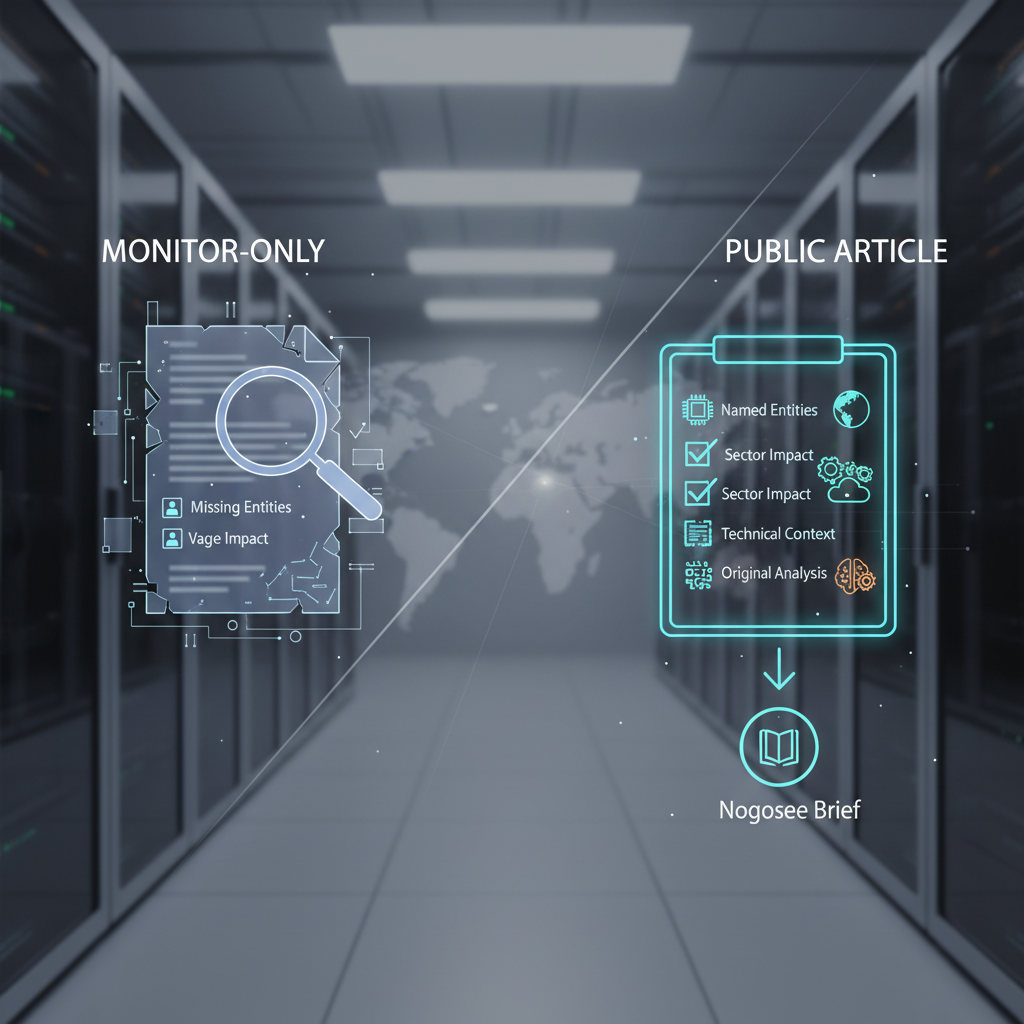
Executive Summary: This checklist guides security and AI governance teams in determining whether an East Asia AI incident signal warrants a public Nogosee article or should remain monitor-only, based on evidence quality, affected entities, user harm, and uncertainty tracking, using Nogosee’s source coverage methodology as a workflow framework.
Why It Matters
Nogosee’s methodology treats all incoming signals as monitor-only records by default, reserving public article status for those that meet specific evidentiary and operational thresholds. For East Asia AI incidents, this means requiring named entities (e.g., specific organizations in Taiwan, Japan, or Korea), sector-specific impacts (such as disruptions to cloud infrastructure, AI model deployment, or identity systems), and technical context grounded in local sources like public CERTs, vulnerability disclosures, or verified incident reports. Without these elements, even a seemingly significant AI-related event remains in the tracker as a monitor-only record, searchable but not elevated to a public brief. The core principle is that monitor-only status is not a downgrade—it reflects disciplined filtering to preserve signal quality.
Operational relevance is the key differentiator between monitor-only and public article status. A signal must offer actionable insight for global security, AI, cloud, or infrastructure teams—not just describe an event. For example, a ransomware attack on a Korean AI startup only becomes publishable if it reveals novel TTPs, exposes supply-chain risks in AI training data, or highlights gaps in model governance that others can learn from. Similarly, an AI misuse incident reported by Taiwan’s CERT gains article status if it includes technical details about prompt injection vectors or model inversion techniques that defenders can operationalize. Generic summaries, vendor press releases, or duplicate alerts without unique context do not meet this bar.
Technical Signal
Evidence quality and uncertainty tracking are critical throughout the assessment process. Teams must avoid inferring impact, attributing motives, or claiming scope beyond what the source explicitly states. If a source mentions an AI model breach but does not confirm data exfiltration, user harm, or system downtime, those uncertainties should be acknowledged rather than filled in. Nogosee’s workflow encourages labeling such gaps explicitly and revisiting the signal as new information emerges—this is not a failure of monitoring but a feature of evidence-based intelligence. Over time, a monitor-only record may accumulate enough context to cross the threshold for publication.
Ownership and escalation paths ensure consistent application of these criteria. In practice, security or AI governance teams using Nogosee’s tracker should assign clear ownership for signal review, define escalation triggers (e.g., when a monitor-only record gains named entities or technical depth), and schedule regular reviews—such as in weekly risk meetings—where decisions are documented. Exporting CSV slices of monitor-only records allows teams to filter by sector, source, or date and apply consistent criteria. The goal is not to maximize article volume but to maintain a high-signal, source-grounded intelligence feed that supports timely, informed decisions across global operations.
Operational Impact
Treat the official source as a monitoring input, not as proof that every feed entry deserves a public article. The practical value is a repeatable triage layer: capture the source title, original URL, visible publication date, affected product or service when available, and the operational surface involved. When those fields are thin or ambiguous, the item should stay in the tracker as monitoring data rather than becoming a standalone post.
For readers watching East Asia, the escalation question is whether the notice touches a real local, national, regional, sector, or operating dependency. Supplier exposure, cloud identity, telecom, financial services, government systems, semiconductor or manufacturing links, public-sector technology, managed service providers, and internet-facing infrastructure are strong signals even before global media frames them as cross-border events.
What To Watch
A healthy workflow separates three outcomes. Routine items become searchable tracker records. Items with clear patch urgency, exploitation language, named affected technology, or cross-border supplier relevance become article candidates. Items that are old, duplicated, underspecified, or mostly vendor boilerplate should remain monitor-only even if they contain familiar cybersecurity keywords.
The useful reader task is comparison. Analysts should ask whether the same vendor, CVE family, attack surface, sector, or region appears across multiple sources. A single notice can be weak by itself, while a cluster across CERT, vendor, and security research sources can justify a higher-priority brief. Nogosee should preserve that distinction so the site behaves like an intelligence tracker instead of a rewrite feed.
For structured coverage, tag each record consistently by region, source, sector, technology surface, and monitoring status. That makes the database useful even on quiet news days because readers can still filter for AI Security, Cloud Infrastructure, Cybersecurity, Government, Technology, inspect current watchlist records, and decide which official source deserves direct follow-up.
Event Type: security
Importance: medium
Affected Sectors
- AI Security
- Cloud Infrastructure
- Cybersecurity
- Government
- Technology
Frequently Asked Questions
What makes an East Asia AI incident signal eligible for a public Nogosee article?
An East Asia AI incident signal becomes a public article when it includes named entities, sector-specific impacts, technical context from Taiwan, Japan, or Korea sources, and offers operational relevance with original English analysis. Without these, it remains monitor-only.
How should teams handle uncertainty when assessing an East Asia AI incident for publication?
Teams should track uncertainty explicitly, avoid overclaiming, and use flexible review language. If key facts like affected entities or technical details are missing or unverified, the signal should remain monitor-only until more context emerges, per Nogosee’s evidence-first approach.
Who owns the decision to escalate a monitor-only East Asia AI signal to a public article?
The decision is owned by the editorial or intelligence team responsible for signal review, using Nogosee’s tracker as a monitoring layer. Clear ownership and escalation paths should be documented in weekly risk meetings or alerting workflows.
Can a global AI vendor story be included in the East Asia tracker as a public article?
Only if it demonstrates clear relevance to East Asia operators, vendors, or affected sectors—such as intersecting with Taiwan, Japan, or Korea-based cloud, AI, or infrastructure use—and provides operational value beyond generic global reporting.