Answer Brief
Use Nogosee's East Asia Cyber Risk Tracker to convert CERT alerts from Taiwan, Japan, and Korea into structured supplier questions about scope, versioning, deployment footprint, and compensating controls—without requiring numeric thresholds or rigid deadlines.
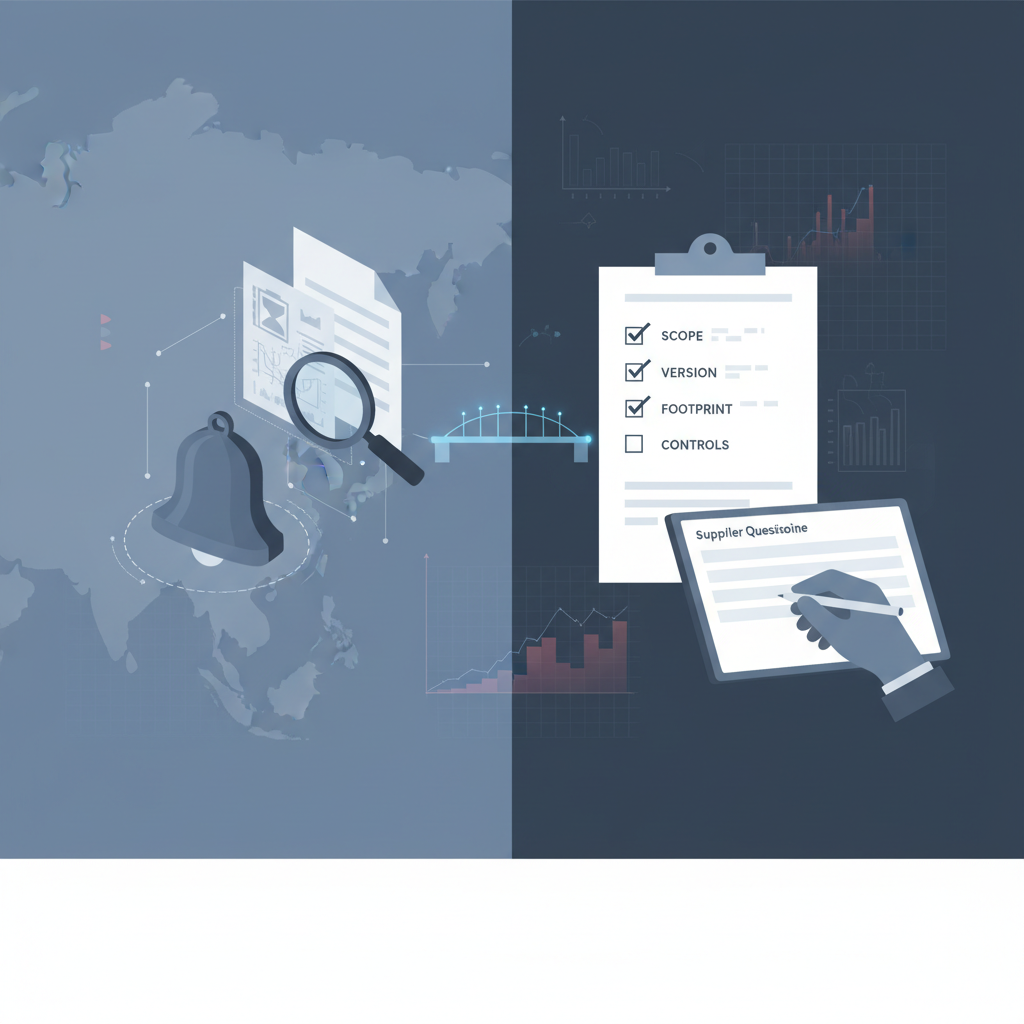
Executive Summary: Use Nogosee's East Asia Cyber Risk Tracker to convert CERT alerts from Taiwan, Japan, and Korea into structured supplier questions about scope, versioning, deployment footprint, and compensating controls—without requiring numeric thresholds or rigid deadlines.
Why It Matters
Nogosee’s East Asia Cyber Risk Tracker functions as a monitoring layer for public signals from sources like TWCERT/CC, JVN, and KrCERT, providing structured, English-accessible records that security and supplier-risk teams can use to build practical workflows. Rather than treating each alert as an urgent incident, the tracker enables teams to convert raw CERT notices into repeatable supplier questionnaires by focusing on verifiable facts: which products are mentioned, what versions are affected, and whether the alert includes indicators of compromise or just vulnerability details. This approach reduces alert fatigue by shifting from reactive panic to proactive, evidence-based vendor engagement. The process begins with searching the tracker using relevant terms—such as a CVE ID, product name, or source family like 'JVN'—then inspecting the resulting signals to confirm relevance, recency, and source credibility before proceeding. Teams should treat Nogosee as a starting point, not a conclusion: always open the linked source record (e.g., a TWCERT/CC advisory) to validate the alert’s scope, check for updates, and compare with nearby signals in the same region or sector to avoid acting on isolated or outdated information. When drafting supplier questions, focus on scope (e.g., 'Is this product used in your environment?'), versioning (e.g., 'Which specific versions are deployed?'), deployment footprint (e.g., 'Is it internet-facing or internal only?'), and compensating controls (e.g., 'Are WAF rules, network segmentation, or monitoring in place?'). Avoid asking for binary 'yes/no' answers about exposure; instead, request evidence such as configuration screenshots, asset inventory excerpts, or control documentation. Ownership of this workflow should sit with supplier-risk or procurement security teams, who can coordinate with IT and cloud operations to interpret responses. Escalation should be flexible: route items for review if a supplier cannot provide version details, gives conflicting answers across departments, or fails to respond within a reasonable window—never enforce fixed deadlines, but use Nogosee’s monitoring status to track whether new signals (e.g., a patch advisory) emerge that change the risk context. Next actions include saving the supplier or product as a watchlist item in the tracker, setting up periodic re-checks for related signals, and using the tracker’s export functions (CSV, RSS) to feed into existing vendor risk management tools. Crucially, this method does not require numeric thresholds, percentages, or publication lag claims—it relies solely on the tracker’s structured signals and the user’s verification of source records. By grounding supplier engagement in observable, source-backed facts from East Asia CERTs, teams gain early visibility into regional risk patterns without overclaiming impact or inventing connections where none exist.
Treat the official source as a monitoring input, not as proof that every feed entry deserves a public article. The practical value is a repeatable triage layer: capture the source title, original URL, visible publication date, affected product or service when available, and the operational surface involved. When those fields are thin or ambiguous, the item should stay in the tracker as monitoring data rather than becoming a standalone post.
Technical Signal
For readers watching East Asia, the escalation question is whether the notice touches a real local, national, regional, sector, or operating dependency. Supplier exposure, cloud identity, telecom, financial services, government systems, semiconductor or manufacturing links, public-sector technology, managed service providers, and internet-facing infrastructure are strong signals even before global media frames them as cross-border events.
A healthy workflow separates three outcomes. Routine items become searchable tracker records. Items with clear patch urgency, exploitation language, named affected technology, or cross-border supplier relevance become article candidates. Items that are old, duplicated, underspecified, or mostly vendor boilerplate should remain monitor-only even if they contain familiar cybersecurity keywords.
Operational Impact
The useful reader task is comparison. Analysts should ask whether the same vendor, CVE family, attack surface, sector, or region appears across multiple sources. A single notice can be weak by itself, while a cluster across CERT, vendor, and security research sources can justify a higher-priority brief. Nogosee should preserve that distinction so the site behaves like an intelligence tracker instead of a rewrite feed.
For structured coverage, tag each record consistently by region, source, sector, technology surface, and monitoring status. That makes the database useful even on quiet news days because readers can still filter for supply-chain, vendor-risk, security-operations, inspect current watchlist records, and decide which official source deserves direct follow-up.
Event Type: security
Importance: medium
Affected Sectors
- security-operations
- supply-chain
- vendor-risk
Frequently Asked Questions
How do I start converting a CERT alert from Nogosee's tracker into a supplier question?
Begin by selecting a signal from the tracker—such as a TWCERT/CC, JVN, or KrCERT notice—then open the linked source record to verify the alert’s scope, affected products, and publication date before drafting any questions.
What should I ask suppliers about when a CERT alert mentions a vulnerability in a specific product version?
Ask suppliers to confirm which versions of the affected product are in use, whether the vulnerable version is deployed in production or test environments, and if any compensating controls (like network segmentation or WAF rules) are in place.
When should I escalate a supplier’s response to a CERT-derived questionnaire?
Escalate for review if the supplier cannot confirm version usage, lacks evidence of compensating controls, or provides inconsistent answers across teams—use Nogosee’s workflow to route unclear items for further verification.
How do I avoid creating panic when sending supplier questions based on East Asia CERT alerts?
Frame questions as routine risk checks, not incident responses; focus on factual verification (e.g., 'Are you running version X?') rather than assuming exposure, and allow suppliers time to respond with evidence.
Can I use Nogosee’s tracker to monitor if a supplier has updated their status after a CERT alert?
Yes—save the supplier or product as a watchlist item in the tracker, then re-check for new signals (e.g., patches, advisories, or incident updates) related to that entity before making operational decisions.