Answer Brief
This tutorial provides a step-by-step workflow for determining when a global vendor story should be elevated to a public article in Nogosee’s East Asia Cyber & AI Risk Tracker versus remaining as a monitor-only record, based on source grounding, regional relevance, and operational value for security and infrastructure teams.
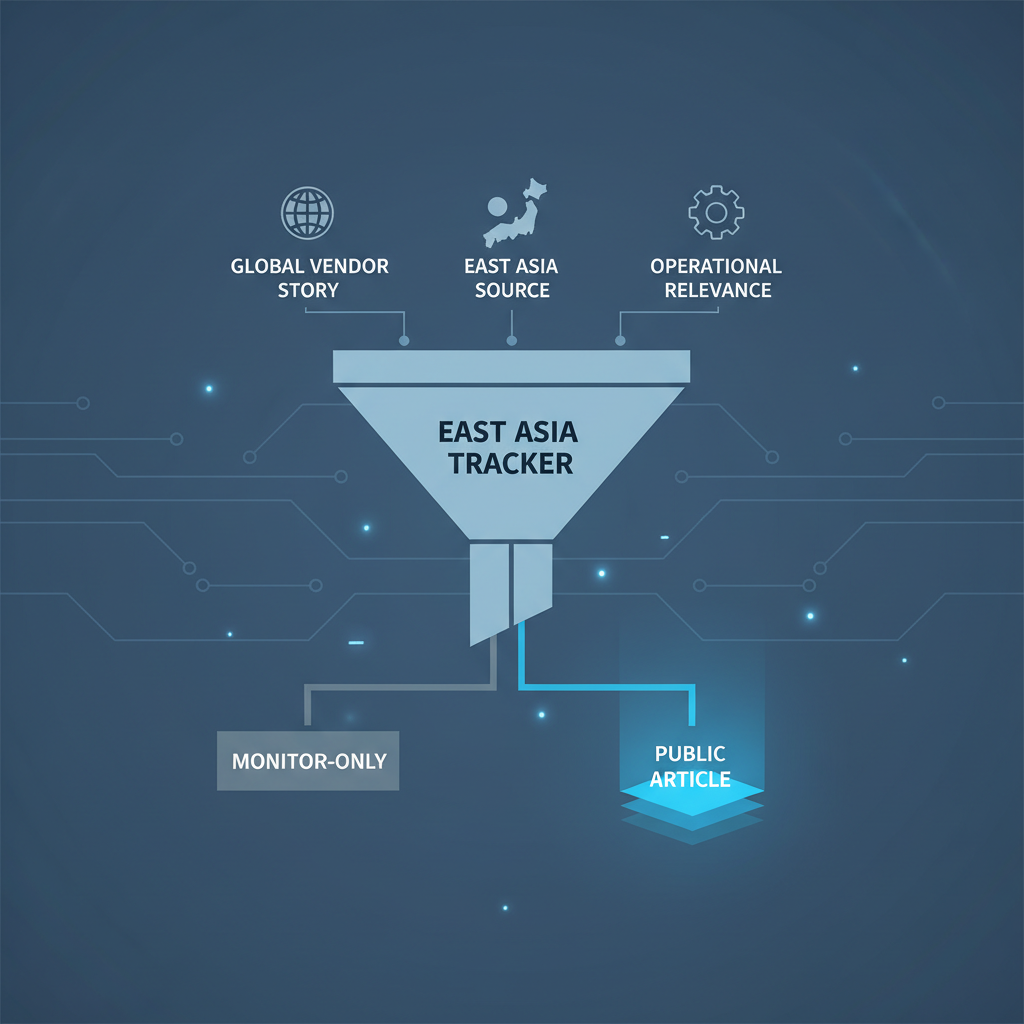
Executive Summary: This tutorial provides a step-by-step workflow for determining when a global vendor story should be elevated to a public article in Nogosee’s East Asia Cyber & AI Risk Tracker versus remaining as a monitor-only record, based on source grounding, regional relevance, and operational value for security and infrastructure teams.
Why It Matters
This tutorial provides a practical, source-grounded workflow for determining when a global vendor story should be elevated to a public intelligence brief in Nogosee’s East Asia Cyber & AI Risk Tracker versus remaining as a monitor-only record. The core principle is that not every global vendor announcement, advisory, or incident report warrants a full article—only those that meet specific criteria for source grounding, regional relevance, and operational value. The methodology emphasizes evidence over volume, ensuring that the tracker maintains high signal value for security, cloud, AI, and infrastructure teams monitoring East Asia-facing risks.
The first decision criterion is whether the story includes named entities, sector-specific impacts, and technical context originating from Taiwan, Japan, or Korea sources. Without these elements, the story lacks the necessary regional anchoring to qualify as an East Asia signal, even if it involves a global vendor. For example, a vague global patch notice from a multinational cloud provider with no mention of deployment, impact, or response in East Asia would remain monitor-only. However, if the same advisory includes details about affected systems in Taiwanese government agencies, Japanese critical infrastructure, or Korean financial networks, it gains operational relevance.
Technical Signal
Second, the story must offer original English analysis that goes beyond summarizing the source. Nogosee does not publish rewritten press releases or vendor advisories as breaking news. Instead, public articles require synthesis—explaining why the signal matters for global readers, what TTPs or trends it reveals, and how it affects risk management for cloud, identity, or supply-chain teams. If the source only provides a headline or bullet-point alert without technical depth or contextual insight, it should not be elevated.
Third, operational relevance for global security, AI, cloud, or infrastructure teams is essential. A story becomes a public article when it helps readers understand emerging threats, vulnerability exposures, or defensive practices relevant to East Asia operators—such as how a vendor’s AI model update affects privacy compliance in Singapore, or how a cloud misconfiguration pattern observed in Korea could indicate broader supply-chain risks. This relevance justifies the article’s inclusion in a global intelligence feed despite its regional origin.
Operational Impact
The workflow also clarifies what Nogosee does not disclose: internal scoring weights, automation thresholds, query baskets, or commercial feed mechanics. This protects the integrity of the monitoring system while allowing transparency about editorial standards. Teams using the tracker should rely on the public slice and source-linked records, not assume that every monitored item will become an article.
Finally, the tutorial reinforces that the decision to publish is not automatic. RSS feeds and source-list items are first treated as monitoring records. Only those that clear the quality gate—offering sufficient context, factual consistency, language quality, and original analysis—become public articles. Readers are encouraged to use Nogosee’s CSV exports, role-based alerting workflows, and daily review queues to apply these criteria consistently in their own risk monitoring processes.
What To Watch
Treat the official source as a monitoring input, not as proof that every feed entry deserves a public article. The practical value is a repeatable triage layer: capture the source title, original URL, visible publication date, affected product or service when available, and the operational surface involved. When those fields are thin or ambiguous, the item should stay in the tracker as monitoring data rather than becoming a standalone post.
For readers watching East Asia, the escalation question is whether the notice touches a real local, national, regional, sector, or operating dependency. Supplier exposure, cloud identity, telecom, financial services, government systems, semiconductor or manufacturing links, public-sector technology, managed service providers, and internet-facing infrastructure are strong signals even before global media frames them as cross-border events.
A healthy workflow separates three outcomes. Routine items become searchable tracker records. Items with clear patch urgency, exploitation language, named affected technology, or cross-border supplier relevance become article candidates. Items that are old, duplicated, underspecified, or mostly vendor boilerplate should remain monitor-only even if they contain familiar cybersecurity keywords.
The useful reader task is comparison. Analysts should ask whether the same vendor, CVE family, attack surface, sector, or region appears across multiple sources. A single notice can be weak by itself, while a cluster across CERT, vendor, and security research sources can justify a higher-priority brief. Nogosee should preserve that distinction so the site behaves like an intelligence tracker instead of a rewrite feed.
Event Type: security
Importance: medium
Affected Sectors
- Cloud Infrastructure
- Cybersecurity
- Finance
- Government
- Technology
Frequently Asked Questions
What makes a global vendor story eligible for a public article in Nogosee’s East Asia tracker?
A global vendor story becomes a public article only when it includes named entities, sector-specific impacts, and technical context tied to Taiwan, Japan, or Korea, and offers original English analysis with operational relevance for global security, AI, or infrastructure teams.
When should a global vendor story remain as a monitor-only record instead of becoming a public article?
It should remain monitor-only if it lacks named entities, sector-specific impacts, or technical context from East Asia sources, or if it is a thin vendor notice, duplicate alert, or low-value summary without original analysis or clear relevance to East Asia-facing operations.
How should security teams use Nogosee’s tracker when reviewing global vendor stories?
Teams should use the tracker to filter, review, and triage signals based on evidence—not volume—applying source-grounding criteria to decide whether to escalate to a ticket, watchlist, or executive brief, while preserving the original source link for verification.
Who owns the decision to elevate a global vendor story to a public article in Nogosee’s workflow?
The decision is owned by the editorial or intelligence team responsible for signal triage, guided by documented criteria for source grounding, regional relevance, and operational value, with escalation paths defined for ambiguous cases.
What should readers monitor next after applying this vendor story filter?
Readers should monitor for updates in the Nogosee tracker that meet the source-grounded East Asia cyber signal criteria—particularly those with named entities, sector-specific impacts, and technical context from Taiwan, Japan, or Korea—and use CSV exports or role-based alerts to structure recurring reviews.