Answer Brief
This guide provides step-by-step instructions for security teams to compare CERT and vulnerability signals from Taiwan, Japan, and Korea using Nogosee's public tracker for a single vendor, product, or dependency. It outlines how to search, inspect, verify, and act on regional signals without implying real-time urgency or inventing thresholds.
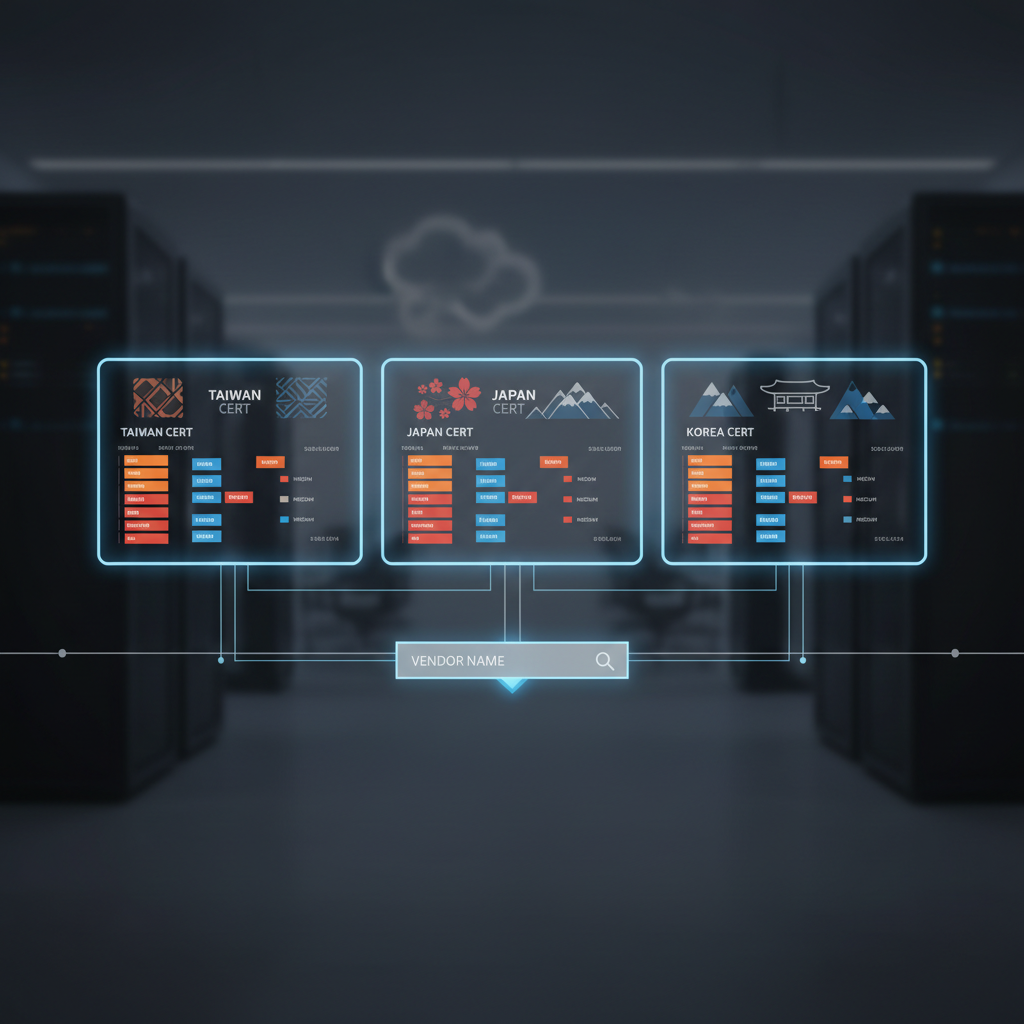
Executive Summary: This guide provides step-by-step instructions for security teams to compare CERT and vulnerability signals from Taiwan, Japan, and Korea using Nogosee's public tracker for a single vendor, product, or dependency. It outlines how to search, inspect, verify, and act on regional signals without implying real-time urgency or inventing thresholds.
Why It Matters
Security teams monitoring vendor risk across East Asia often face fragmented signals from Taiwan, Japan, and Korea’s CERTs and vulnerability feeds. Nogosee’s public tracker offers a structured way to compare these signals for a single vendor, product, or dependency without requiring direct access to multiple local sources. The process begins with a focused search using the vendor name, product identifier, or dependency as the query term. Users should apply regional filters to isolate records from Taiwan, Japan, and Korea, enabling side-by-side comparison of signal frequency, timing, and type. This approach supports early detection of divergent disclosure patterns or regional risk concentrations that might otherwise go unnoticed.
Once signals are retrieved, the next step is inspection. Each record should be opened to access the source-linked record, where teams can verify the original advisory, check publication dates, and assess the signal’s priority level within the tracker. It is critical to consult related collection pages when a signal lacks context—for example, to determine if a CVE is linked to known exploitation or if a vendor statement reflects an ongoing incident. Nogosee emphasizes treating its platform as a monitoring layer: the tracker enriches and normalizes data, but operational decisions must be grounded in the original source.
Technical Signal
For ongoing monitoring, teams can export data using capped CSV, indicator CSV, RSS feeds, or copyable briefs directly from the tracker interface. These outputs support repeatable workflows such as watchlist updates or ticket generation in SOC systems. For teams requiring deeper historical analysis or custom monitoring schedules, Nogosee provides an API Access request form to obtain full feeds or tailored exports. This flexibility allows organizations to align signal ingestion with their internal review cycles without over-reliance on real-time alerts.
The tracker’s dashboard lens and regional heat map offer additional context, showing live signal counts per region—Taiwan (304), Japan (259), Korea (246), and Thailand watchlist (351) at the time of the source snapshot. While these numbers reflect overall activity, they should not be used as benchmarks for vendor-specific risk. Instead, teams should focus on trends within their filtered query results, such as clustering of signals around a specific product line or timing relative to patch releases.
Operational Impact
Operational responsibility should be distributed across security, cloud, governance, supplier-risk, and research teams. A practical workflow involves assigning a reviewer to conduct regular checks, validate findings with source links, and document discrepancies. Escalation should follow a flexible protocol: consider further review when signals appear in multiple regions or when a source confirms active exploitation, but avoid rigid thresholds. The goal is to maintain situational awareness without creating alert fatigue.
Finally, teams must recognize the tracker’s boundaries. Public search, CSV, RSS, and topic pages are intentionally capped samples. Full feeds, historical exports, and custom monitoring remain request-only, and private query logic is not disclosed. This means the tracker is best used for signal discovery and triage, not as a comprehensive source of truth. By combining Nogosee’s structured access with direct source verification, teams can build a reliable, repeatable process for comparing East Asia CERT signals and strengthening vendor risk management.
What To Watch
Treat the official source as a monitoring input, not as proof that every feed entry deserves a public article. The practical value is a repeatable triage layer: capture the source title, original URL, visible publication date, affected product or service when available, and the operational surface involved. When those fields are thin or ambiguous, the item should stay in the tracker as monitoring data rather than becoming a standalone post.
For readers watching Taiwan, the escalation question is whether the notice touches a real local, national, regional, sector, or operating dependency. Supplier exposure, cloud identity, telecom, financial services, government systems, semiconductor or manufacturing links, public-sector technology, managed service providers, and internet-facing infrastructure are strong signals even before global media frames them as cross-border events.
A healthy workflow separates three outcomes. Routine items become searchable tracker records. Items with clear patch urgency, exploitation language, named affected technology, or cross-border supplier relevance become article candidates. Items that are old, duplicated, underspecified, or mostly vendor boilerplate should remain monitor-only even if they contain familiar cybersecurity keywords.
Event Type: security
Importance: medium
Affected Sectors
- cloud
- governance
- research
- security
- supplier-risk
Frequently Asked Questions
How do I start comparing CERT signals for a vendor across Taiwan, Japan, and Korea?
Begin by searching Nogosee's tracker using the vendor name, product, or dependency as your query term. Filter results by region to isolate signals from Taiwan, Japan, and Korea. Use the 'Search' function with the vendor as the entity and apply regional filters to view side-by-side signal entries from each jurisdiction.
What should I check when inspecting signals from different East Asia CERT sources?
Open each source-linked record to verify authenticity, compare publication dates, assess signal priority, and review related collection pages for context. Treat Nogosee as a monitoring layer—always cross-check with the original source before making operational decisions, and note any discrepancies in timing or severity across regions.
How can I use exported data for ongoing vendor risk monitoring?
Use Nogosee's capped CSV, indicator CSV, RSS, or copyable briefs to build repeatable workflows. For larger datasets or custom feeds, submit a request via the API Access form. Integrate outputs into your internal watchlist or ticketing system to track signal evolution over time without relying on real-time alerts.
Who is responsible for verifying and acting on CERT signal comparisons?
Security, cloud, governance, supplier-risk, and research teams should share ownership. Assign a team lead to coordinate weekly reviews, validate findings with source links, and escalate only when correlated signals appear across regions or when a source confirms active exploitation. Avoid automatic escalation based on single-region signals.
What are the limitations of using Nogosee's public tracker for CERT signal comparison?
The public interface provides capped samples via CSV, RSS, and topic pages. Full feeds, historical exports, and custom monitoring require a formal request. Private query logic is not published, so teams must verify signal completeness independently. Use the tracker as a discovery tool, not a definitive source of record.