Answer Brief
This practical tutorial guides security teams in using the CISA Known Exploited Vulnerabilities (KEV) catalog to create a focused, actionable patch watchlist for East Asia-based suppliers. It outlines steps to map KEVs to supplier software inventories, assign ownership, set flexible escalation thresholds, and maintain evidence records—without relying on numeric thresholds or rigid schedules.
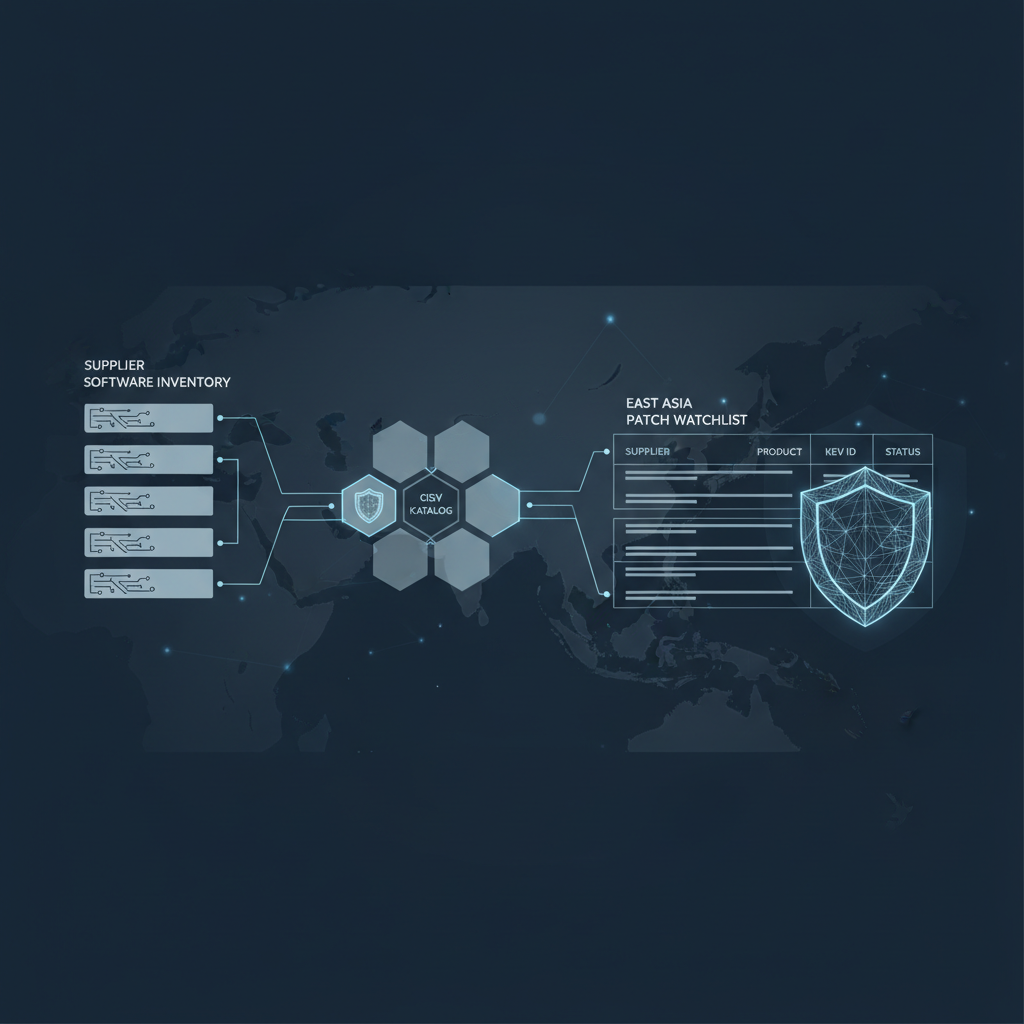
Executive Summary: This practical tutorial guides security teams in using the CISA Known Exploited Vulnerabilities (KEV) catalog to create a focused, actionable patch watchlist for East Asia-based suppliers. It outlines steps to map KEVs to supplier software inventories, assign ownership, set flexible escalation thresholds, and maintain evidence records—without relying on numeric thresholds or rigid schedules.
Why It Matters
Building a supplier patch watchlist using the CISA KEV catalog requires a disciplined yet adaptable approach tailored to East Asia supply chains. Begin by accessing the official CISA KEV catalog at https://www.cisa.gov/known-exploited-vulnerabilities-catalog as the authoritative source of actively exploited vulnerabilities. Avoid treating it as a real-time feed; instead, review it on a regular but non-rigid basis—such as when onboarding new suppliers or during quarterly risk reviews—to prevent alert fatigue while maintaining relevance.
Next, map each KEV entry to your East Asia supplier software inventory. This involves comparing the vendor, product, and version fields in the KEV entry against the software components used by your suppliers in Taiwan, Japan, Korea, Singapore, or other East Asia locations. Prioritize exact matches; avoid inferring risk from product families or version ranges unless explicitly confirmed by the supplier. Maintain a centralized record—such as a shared database or tracked spreadsheet—that logs each KEV-supplier-product linkage.
Technical Signal
Ownership is critical for sustainability. Assign a vendor risk manager to oversee the watchlist process, coordinate with technical teams, and ensure updates are communicated. Technical owners—such as platform or application specialists—should validate whether a KEV applies to their supplier’s actual deployment and confirm patch applicability. Avoid siloing this responsibility; instead, use lightweight coordination mechanisms like shared tags or ticketing system links to maintain visibility.
Escalation should be guided by context, not arbitrary rules. Consider escalating when a KEV affects a supplier providing critical components (e.g., semiconductors, cloud services, or financial software), when the vulnerable system is internet-facing or privileged, or when the supplier has not acknowledged or remediated the issue within a reasonable period. However, avoid fixed timelines like ‘48 hours’ or ‘two weeks’; instead, base decisions on exploit activity, supplier transparency, and compensatory controls. Document the reasoning behind each escalation or acceptance decision to support audits and future refinement.
Operational Impact
Finally, treat the watchlist as a living artifact. Regularly verify that recorded information remains accurate—especially after supplier software updates or new KEV additions. Preserve evidence such as CISA KEV URLs, supplier advisory references, and internal assessment notes. This creates a traceable trail for internal reviews, regulator inquiries, or supplier negotiations. By focusing on mapping, ownership, judgment-based escalation, and evidence retention—without relying on numeric targets or rigid schedules—teams can build a practical, high-signal watchlist that enhances East Asia supplier risk management without introducing unnecessary complexity.
Treat the official source as a monitoring input, not as proof that every feed entry deserves a public article. The practical value is a repeatable triage layer: capture the source title, original URL, visible publication date, affected product or service when available, and the operational surface involved. When those fields are thin or ambiguous, the item should stay in the tracker as monitoring data rather than becoming a standalone post.
What To Watch
For readers watching East Asia, the escalation question is whether the notice touches a real local, national, regional, sector, or operating dependency. Supplier exposure, cloud identity, telecom, financial services, government systems, semiconductor or manufacturing links, public-sector technology, managed service providers, and internet-facing infrastructure are strong signals even before global media frames them as cross-border events.
A healthy workflow separates three outcomes. Routine items become searchable tracker records. Items with clear patch urgency, exploitation language, named affected technology, or cross-border supplier relevance become article candidates. Items that are old, duplicated, underspecified, or mostly vendor boilerplate should remain monitor-only even if they contain familiar cybersecurity keywords.
The useful reader task is comparison. Analysts should ask whether the same vendor, CVE family, attack surface, sector, or region appears across multiple sources. A single notice can be weak by itself, while a cluster across CERT, vendor, and security research sources can justify a higher-priority brief. Nogosee should preserve that distinction so the site behaves like an intelligence tracker instead of a rewrite feed.
For structured coverage, tag each record consistently by region, source, sector, technology surface, and monitoring status. That makes the database useful even on quiet news days because readers can still filter for technology, manufacturing, finance, critical infrastructure, inspect current watchlist records, and decide which official source deserves direct follow-up.
Event Type: security
Importance: medium
Affected Sectors
- critical infrastructure
- finance
- manufacturing
- technology
Frequently Asked Questions
What is the CISA KEV catalog and why is it useful for East Asia supplier risk management?
The CISA Known Exploited Vulnerabilities (KEV) catalog is a U.S. government-maintained list of vulnerabilities actively exploited in the wild. It helps East Asia-facing security teams prioritize patching efforts by focusing on real-world exploited flaws, reducing noise from theoretical risks when assessing supplier software exposure.
How should I map KEVs to my East Asia supplier software inventory?
Cross-reference each CISA KEV entry with your supplier’s disclosed or discovered software inventory—including operating systems, applications, and firmware. Focus on exact product and version matches. Maintain a living spreadsheet or database linking each KEV ID to affected suppliers, products, and observed versions.
Who should own the East Asia supplier patch watchlist process?
Assign ownership to a cross-functional team including vendor risk management, vulnerability management, and procurement leads. The vendor risk lead should coordinate updates, while technical owners validate applicability and patch status. Clear ownership ensures accountability without overburdening any single role.
When should I escalate a KEV finding related to an East Asia supplier?
Escalate when a KEV applies to a critical supplier, affects internet-facing systems, or lacks a timely patch or mitigation plan. Use flexible judgment based on business impact, exploit maturity, and supplier responsiveness—not fixed thresholds. Document the rationale for each escalation decision.
What evidence should I record when maintaining the watchlist?
Record the KEV ID, supplier name, affected product and version, date of discovery, patch status, mitigation status, owner, and rationale for escalation or acceptance. Preserve links to the original CISA KEV entry and any supplier communications. This supports auditability and future review.