Answer Brief
When a Japanese vendor publishes a critical vulnerability through the JVN feed, global security teams should follow a structured verification process: confirm asset exposure using specific product identifiers, assess technical exploitability via CVSS and attack details, verify patch availability and remediation paths, assign clear ownership, and apply risk-based escalation thresholds—prioritizing verified facts over assumptions to turn JVN entries into actionable intelligence.
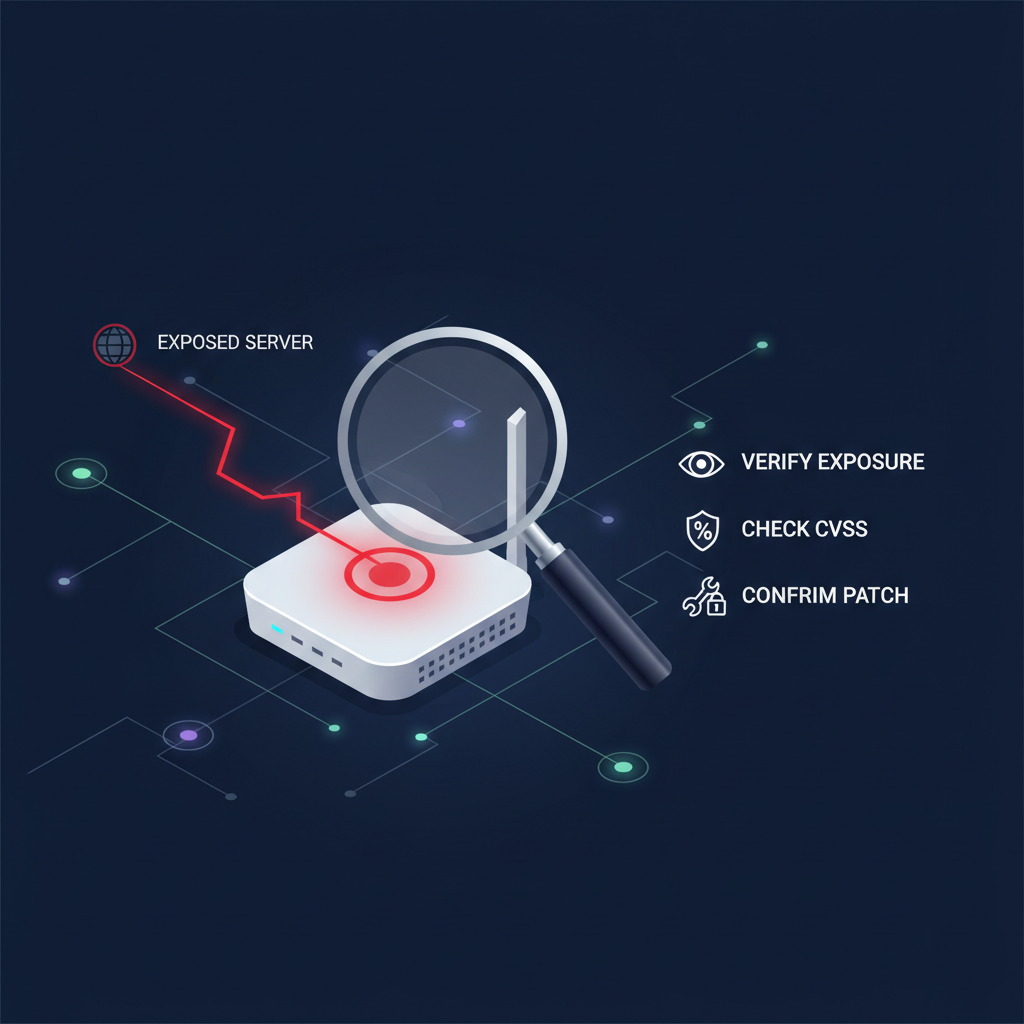
Executive Summary: When a Japanese vendor publishes a critical vulnerability through the JVN feed, global security teams should follow a structured verification process: confirm asset exposure using specific product identifiers, assess technical exploitability via CVSS and attack details, verify patch availability and remediation paths, assign clear ownership, and apply risk-based escalation thresholds—prioritizing verified facts over assumptions to turn JVN entries into actionable intelligence.
Why It Matters
When a Japanese vendor releases a critical CVE through the JVN feed, global security teams must treat it as a potential signal requiring structured verification—not assuming relevance or impact. The first action is to confirm asset exposure by cross-referencing the vulnerability note’s product identifiers (such as ‘Atermシリーズ’ or specific model numbers) with internal configuration management databases or asset inventories. This step avoids unnecessary work on irrelevant vendors and focuses effort where risk may exist. Teams should not rely on vendor name alone; version specificity is critical, as many JVN notes detail vulnerable ranges within a product line.
Next, assess the technical details provided in the JVN note: CVSS score, attack vector (network, local, adjacent), authentication requirements, and exploit availability. A critical CVSS score alone does not mandate urgent action if the attack requires local access or user interaction in a controlled environment. Conversely, a network-adjacent OS command injection in a widely deployed router—like the NV26-003 example in the source—demands immediate scrutiny of perimeter exposure and segmentation. Use the JVN reference to locate the original vendor advisory for exploit proof-of-concept details or mitigation guidance.
Technical Signal
Then, determine patch availability and remediation path. Check if the JVN note links to a vendor advisory, workaround, or update schedule. If no fix is available, evaluate compensating controls such as firewall rules, intrusion prevention signatures, or temporary access restrictions. Document the missing patch as a tracking item with clear ownership—typically assigned to the vendor management or patching team—rather than leaving it open-ended.
Ownership should be defined early: asset owners confirm exposure, security analysts assess risk and exploit context, and patch management validates fix applicability. Avoid assigning blame or assuming delay; instead, focus on whether the team has sufficient information to decide. If the JVN note lacks clarity on versions or impact, treat it as a signal to request clarification from the vendor or monitor for updates—do not assume safety.
Operational Impact
Escalation thresholds should be risk-based, not time-bound. Trigger escalation to incident response or senior leadership if: the asset is internet-facing, no patch or workaround exists, and the vulnerability allows remote code execution or authentication bypass. Use flexible language like ‘consider escalation when the team can verify critical exposure and lack of mitigation’ rather than fixed deadlines. This supports adaptive response without overpromising on timing.
Finally, document the verification steps taken, sources consulted (JVN note URL, vendor advisory), and decisions made. This creates an audit trail and supports future reviews. The goal is not to patch immediately in all cases, but to ensure that any decision—to act, monitor, or defer—is based on verified facts from the source, not speculation. This approach turns a JVN entry into a repeatable, low-noise input for global vulnerability management.
What To Watch
Treat JVN as a monitoring input, not as proof that every feed entry deserves a public article. The practical value is a repeatable triage layer: capture the source title, original URL, visible publication date, affected product or service when available, and the operational surface involved. When those fields are thin or ambiguous, the item should stay in the tracker as monitoring data rather than becoming a standalone post.
For readers watching Japan, the escalation question is whether the notice touches a real local, national, regional, sector, or operating dependency. Supplier exposure, cloud identity, telecom, financial services, government systems, semiconductor or manufacturing links, public-sector technology, managed service providers, and internet-facing infrastructure are strong signals even before global media frames them as cross-border events.
A healthy workflow separates three outcomes. Routine items become searchable tracker records. Items with clear patch urgency, exploitation language, named affected technology, or cross-border supplier relevance become article candidates. Items that are old, duplicated, underspecified, or mostly vendor boilerplate should remain monitor-only even if they contain familiar cybersecurity keywords.
The useful reader task is comparison. Analysts should ask whether the same vendor, CVE family, attack surface, sector, or region appears across multiple sources. A single notice can be weak by itself, while a cluster across CERT, vendor, and security research sources can justify a higher-priority brief. Nogosee should preserve that distinction so the site behaves like an intelligence tracker instead of a rewrite feed.
Event Type: security
Importance: high
Affected Companies
- NEC Corporation
Affected Sectors
- networking
- technology
- telecommunications
Frequently Asked Questions
What is the first step a global security team should take when a Japanese vendor releases a critical CVE via JVN?
The first step is to verify whether your organization uses the affected product or version by checking the JVN note for specific product names, model numbers, and version ranges against your asset inventory.
How should teams assess exploitability when reviewing a JVN vulnerability note?
Teams should review the CVSS score, attack vector, and exploit availability details in the JVN note to determine if the vulnerability is remotely exploitable, requires authentication, or has public exploit code—prioritizing based on actual risk to exposed assets.
When should a global team escalate internally after identifying exposure to a Japanese vendor CVE?
Escalate to incident response or vendor management if the asset is internet-facing, lacks compensating controls, and either no patch is available or the fix requires complex coordination—triggering a review based on risk, not a fixed timeline.