Answer Brief
Operations and security teams should use a structured scenario-based approach to evaluate whether a Taiwan supplier advisory impacts their systems, vendors, or continuity plans. This guide outlines concrete steps for exposure assessment, ownership, decision criteria, escalation triggers, and next actions without relying on numeric thresholds or implied timelines.
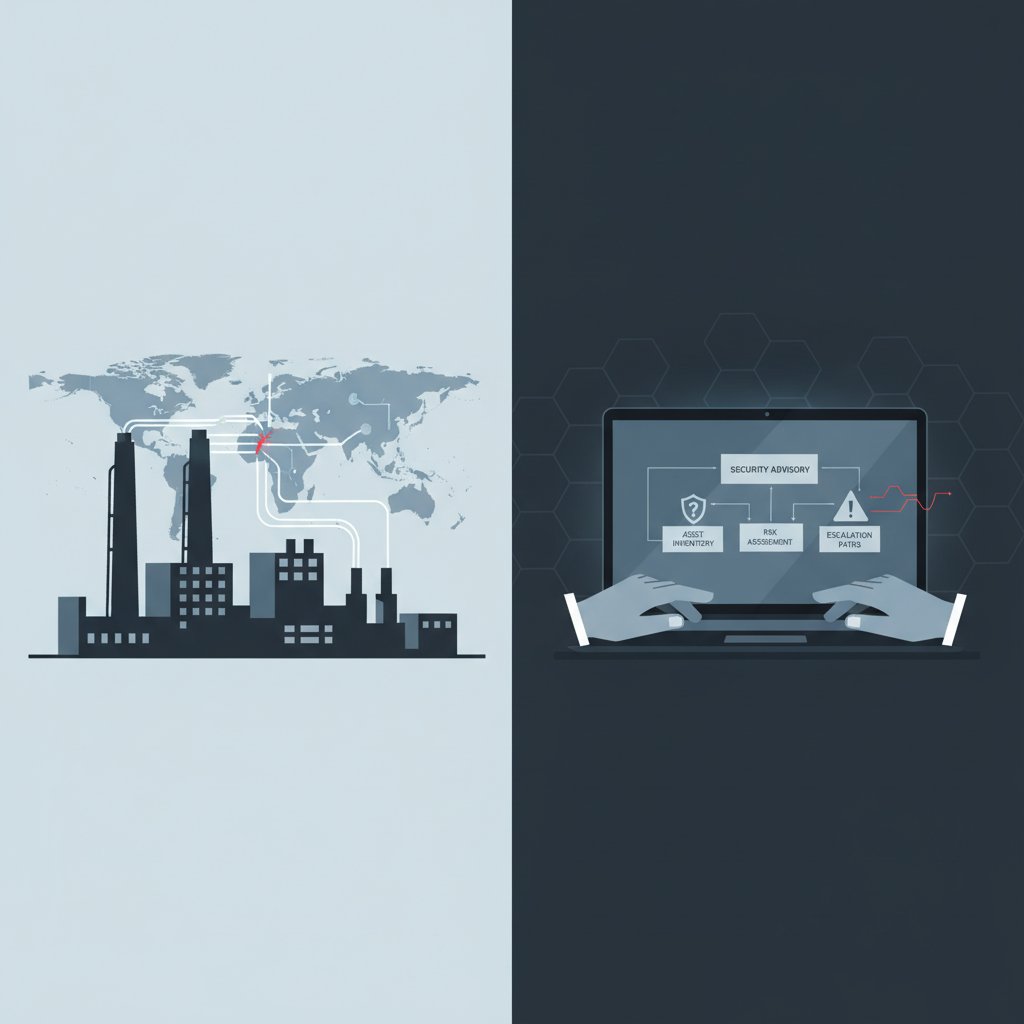
Executive Summary: Operations and security teams should use a structured scenario-based approach to evaluate whether a Taiwan supplier advisory impacts their systems, vendors, or continuity plans. This guide outlines concrete steps for exposure assessment, ownership, decision criteria, escalation triggers, and next actions without relying on numeric thresholds or implied timelines.
Why It Matters
When a Taiwan supplier appears in a security advisory, operations and security teams must avoid reactive assumptions and instead follow a deliberate, scenario-based process to assess exposure. The first step is verification: confirm the advisory originates from a trusted source such as TWCERT/CC or the vendor directly, and extract precise details about the affected product, version, vulnerability type, and severity. This prevents misalignment caused by vague or third-party reporting. Next, teams must consult their internal asset inventory and configuration management databases to determine whether the supplier’s product or service is actually deployed in their environment. Mere presence in a supply chain does not imply risk—only active use or dependency creates exposure. Ownership of this assessment should rest with vendor risk or third-party management teams, who coordinate with technical owners of systems and infrastructure to validate usage and version details. Decision criteria should focus on exploitability within the team’s specific configuration, not just the advisory’s severity score. A critical vulnerability may pose no risk if the affected component is not deployed, is behind strong segmentation, or has compensating controls in place. Conversely, a lower-severity flaw in a widely used, internet-facing component may warrant urgent action. Teams should avoid applying universal thresholds or deadlines; instead, they should use flexible language such as 'consider escalation if' or 'review for potential impact when' to reflect uncertainty and context. Escalation to incident response or business continuity planners is warranted when the advisory signals active exploitation, the affected component is embedded in critical operations, or no timely patch or mitigation is available. At that point, continuity leads should evaluate potential disruption scenarios and prepare contingency plans. Throughout the process, documentation is essential: teams should record their findings, actions taken, and open questions in a centralized risk register. Finally, after initial assessment, teams should establish a monitoring plan to track for updates from TWCERT/CC, the supplier, or related advisories—ensuring the assessment remains current without requiring constant rework. This approach turns a reactive alert into a repeatable, auditable process for supplier risk management.
Treat TWCERT/CC as a monitoring input, not as proof that every feed entry deserves a public article. The practical value is a repeatable triage layer: capture the source title, original URL, visible publication date, affected product or service when available, and the operational surface involved. When those fields are thin or ambiguous, the item should stay in the tracker as monitoring data rather than becoming a standalone post.
Technical Signal
For readers watching Taiwan, the escalation question is whether the notice touches a real local, national, regional, sector, or operating dependency. Supplier exposure, cloud identity, telecom, financial services, government systems, semiconductor or manufacturing links, public-sector technology, managed service providers, and internet-facing infrastructure are strong signals even before global media frames them as cross-border events.
A healthy workflow separates three outcomes. Routine items become searchable tracker records. Items with clear patch urgency, exploitation language, named affected technology, or cross-border supplier relevance become article candidates. Items that are old, duplicated, underspecified, or mostly vendor boilerplate should remain monitor-only even if they contain familiar cybersecurity keywords.
Operational Impact
The useful reader task is comparison. Analysts should ask whether the same vendor, CVE family, attack surface, sector, or region appears across multiple sources. A single notice can be weak by itself, while a cluster across CERT, vendor, and security research sources can justify a higher-priority brief. Nogosee should preserve that distinction so the site behaves like an intelligence tracker instead of a rewrite feed.
For structured coverage, tag each record consistently by region, source, sector, technology surface, and monitoring status. That makes the database useful even on quiet news days because readers can still filter for operations, cybersecurity, supply chain, inspect current watchlist records, and decide which official source deserves direct follow-up.
What To Watch
Readers should use the official source link as the authority for current advisories. Nogosee's role is to translate and organize the signal, explain why it may matter to cyber, AI, cloud, and operations teams, and show when a local Taiwan item becomes relevant to global operators. It should not replace incident-response guidance, vendor documentation, or primary CERT instructions.
Event Type: security
Importance: medium
Affected Sectors
- cybersecurity
- operations
- supply chain
Frequently Asked Questions
What should operations teams do first when they see a Taiwan supplier named in a security advisory?
Teams should immediately verify the advisory’s authenticity via the official TWCERT/CC feed or vendor source, then isolate the advisory’s scope—product, version, and vulnerability type—to determine if the supplier’s component is used in their environment.
Who should own the exposure assessment process when a Taiwan supplier advisory is identified?
The vendor management or third-party risk team should lead initial triage, coordinating with asset inventory and configuration management teams to map the supplier’s product or service against internal systems and dependencies.
When should teams escalate a Taiwan supplier advisory finding to incident response or business continuity planners?
Escalation should occur if the advisory indicates active exploitation, the supplier’s component is embedded in critical systems, or no patch or mitigation is available—triggering review by incident response, continuity planning, and executive risk owners.
What are the key decision criteria for determining if a Taiwan supplier advisory affects internal systems?
Teams should assess whether the supplier’s product is in use, which versions are affected, if the vulnerability is exploitable in their configuration, and whether compensating controls or mitigations exist—based on asset data, not assumptions.
What next actions should follow after assessing exposure to a Taiwan supplier advisory?
Document findings, apply patches or mitigations where available, update vendor risk registers, notify relevant stakeholders, and schedule a review to monitor for updates or related advisories from TWCERT/CC or the supplier.