Answer Brief
Security operations and risk teams can adopt a structured 15-minute daily review process to navigate East Asia cyber and AI risk signals, utilizing the Nogosee tracker as a monitoring layer to filter regional alerts, rank operational relevance, and distribute intelligence through tickets, watchlists, or executive briefs.
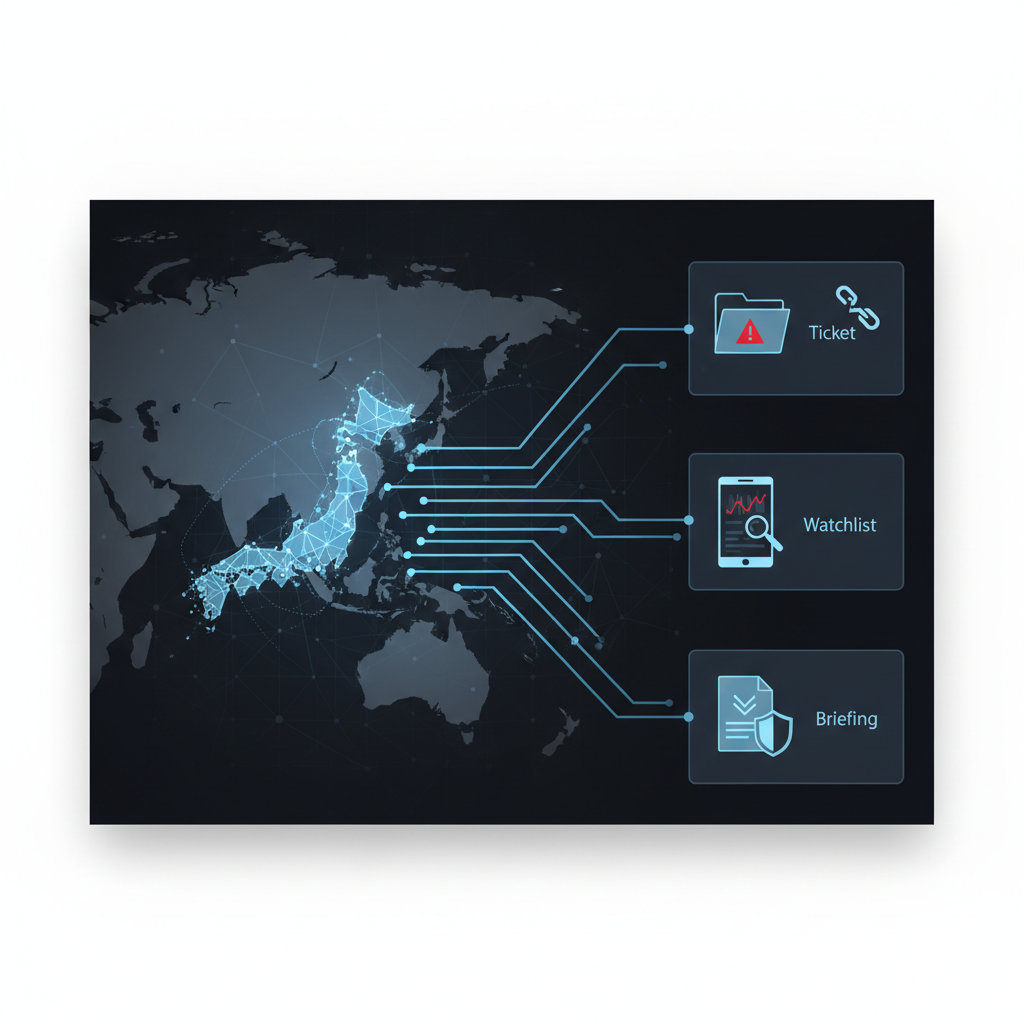
Executive Summary: Security operations and risk teams can adopt a structured 15-minute daily review process to navigate East Asia cyber and AI risk signals, utilizing the Nogosee tracker as a monitoring layer to filter regional alerts, rank operational relevance, and distribute intelligence through tickets, watchlists, or executive briefs.
Why It Matters
The complexity of the East Asia cyber landscape necessitates a disciplined approach to signal triage, moving beyond broad keyword alerts toward a workflow-driven review. By utilizing the Nogosee Cyber & AI Risk Tracker as an intermediary monitoring layer, security teams can effectively filter the high volume of regional data—currently encompassing over 500 public signals across Taiwan, Japan, and Korea—into actionable categories. The initial 15-minute daily window should be dedicated to scanning the 'Priority Radar,' which aggregates signals by freshness and source importance. This ensures that high-priority incident disclosures, such as the recent statements from Hon Hai / Foxconn (2317) or Weikang Technology (6865), are identified immediately without getting lost in the broader stream of procurement records or lower-importance vulnerability notices.
Effective triage requires a clear decision-making framework for signal distribution. Practitioners should evaluate each signal based on its proximity to the organization's technology stack and regional footprint. For example, a Taiwan-based security disclosure affecting the semiconductor supply chain represents a high-priority signal for manufacturing and hardware firms, warranting an immediate ticket or internal briefing. Conversely, government procurement records from the region may serve better as 'watchlist notes,' providing long-term visibility into which technologies are being adopted by regional authorities without requiring an immediate operational response. This differentiation prevents 'alert fatigue' while ensuring that critical shifts in the regional threat landscape are documented.
Technical Signal
Operational context in East Asia is often obscured by language barriers and differing disclosure norms. The tracker addresses this by normalizing signals from various source families, including MOPS disclosures, JVN vulnerability feeds, and KrCERT alerts. During the inspection phase, teams should verify whether a signal is an isolated incident or part of a regional trend. The current data shows a significant concentration of security signals in Taiwan (276 records) compared to Japan (108) and Korea (52). This distribution suggests that Taiwan's rigorous MOPS reporting requirements provide a more transparent view of corporate cybersecurity incidents, which can be used to benchmark risk across the broader sector. Monitoring teams should look for related signals in the same sector to determine if a specific vulnerability or technique is being utilized against multiple regional peers.
Uncertainty remains a core factor in regional intelligence, particularly concerning the lag between an initial incident disclosure and the release of detailed technical indicators. To mitigate this, the daily workflow should prioritize 'source freshness'—checking the last-fetched timestamps to ensure the review is based on the most current data. When a signal is identified, the next step involves verifying the primary source. Because the tracker functions as a monitoring layer, the linked original record provides the necessary technical depth—such as specific CVEs or incident scopes—that may not be fully captured in a high-level summary. Teams should verify the methodology and update cadence of the source (e.g., TWCERT/CC vs. private company filings) before assigning a high-confidence rating to the intelligence.
Operational Impact
The final stage of the workflow focuses on repeatability and the creation of audit trails. By saving watchlists for specific regions or threat themes like 'AI governance' or 'Cloud security,' teams can maintain continuity even as individual analysts rotate. Utilizing RSS feeds for specific queries, such as 'high priority + Taiwan + security,' allows for automated monitoring that supplements the manual daily review. This approach transforms the tracker from a search tool into a proactive intelligence feeder. For larger organizations, exporting these signals into a SIEM or TIP via CSV format enables horizontal analysis across global telemetry, allowing teams to see if regional East Asia signals correlate with scanning activity or identity-based attacks observed in other geographic theaters.
Looking forward, teams should monitor for the expansion of regional watchlists, particularly in emerging centers like Thailand and Singapore, which are increasingly integrated into the East Asia technology supply chain. The goal of this structured review is not merely to capture every signal, but to provide a consistent, source-grounded perspective on regional risk. By focusing on the 'action queue' provided by the triage matrix, analysts can move from passive monitoring to active risk management, ensuring that executive briefs reflect the actual operational reality of the East Asia cyber environment rather than speculative trends.
Event Type: security
Importance: medium
Affected Companies
- Chang Yuan (2030)
- Hon Hai / Foxconn (2317)
- Weikang Technology (6865)
Affected Sectors
- Critical Infrastructure
- Government Procurement
- Security Operations
- Vulnerability Intelligence
Frequently Asked Questions
What are the primary entry points for a daily East Asia signal review?
Effective reviews start with targeted searches by country (Taiwan, Japan, Korea), specific CVE identifiers, entity ticker symbols, or thematic filters such as JVN, KrCERT, MOPS disclosures, or ransomware watchlists.
How should practitioners distinguish between monitoring records and actionable briefs?
Monitoring records are raw signals preserved for source verification, while published briefs represent items that have passed quality checks and show higher operational importance or urgency for security teams.
What is the recommended criteria for escalating a signal to an executive brief?
Escalation to a brief is recommended when a signal demonstrates cross-border impact, affects a core tier-one supplier, involves high-priority vulnerability exploitation, or reflects a major policy shift in regional AI governance.
How does the Priority Radar assist in the triage process?
The Priority Radar ranks signals based on a combination of freshness, source signal strength, and operational relevance, allowing teams to quickly identify high-impact Taiwan MOPS disclosures or Japan-specific vulnerability alerts.
Which data formats are available for integrating these signals into internal SOC tools?
Teams can use capped CSV exports for manual ingestion, indicator-specific CSVs for threat intelligence platforms, or RSS alert feeds for real-time monitoring of specific query parameters.