Answer Brief
This workflow defines how to handle vendor boilerplate security posts in Nogosee’s East Asia Cyber & AI Risk Tracker by establishing a monitor-only lane: what gets logged, when to trigger re-review, and what never becomes a thin article. It provides concrete steps, decision criteria, ownership, and escalation guidance for security and operations teams using the tracker as a monitoring layer.
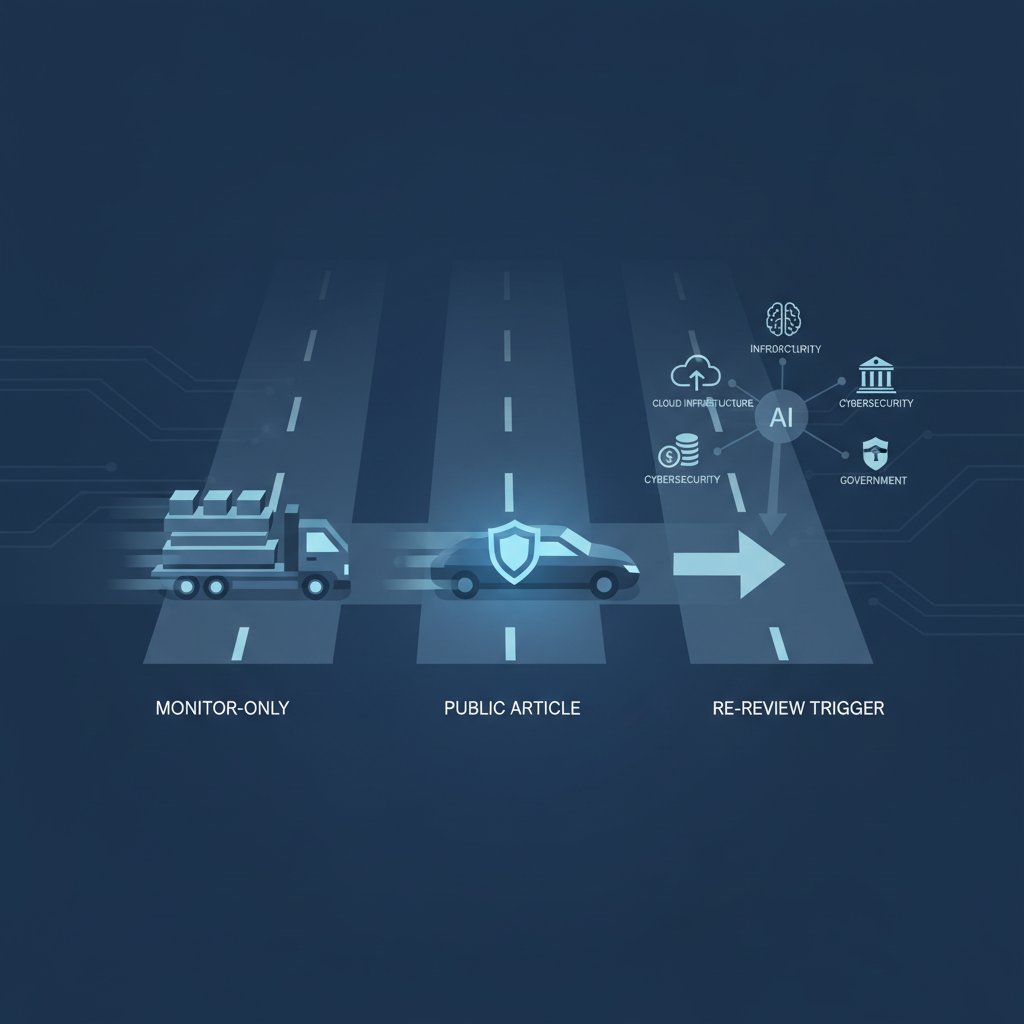
Executive Summary: This workflow defines how to handle vendor boilerplate security posts in Nogosee’s East Asia Cyber & AI Risk Tracker by establishing a monitor-only lane: what gets logged, when to trigger re-review, and what never becomes a thin article. It provides concrete steps, decision criteria, ownership, and escalation guidance for security and operations teams using the tracker as a monitoring layer.
Why It Matters
This workflow establishes a monitor-only lane for vendor boilerplate security posts within Nogosee’s East Asia Cyber & AI Risk Tracker, designed to maintain content quality while preserving monitoring utility. Vendor boilerplate posts—such as generic security advisories, patch notices without exploit details, or non-specific threat summaries—often lack the named entities, sector-specific impacts, or technical context required to become public intelligence briefs. Instead of discarding them, these items are logged as monitor-only records, retained in the tracker for potential future re-evaluation. The core principle is that monitor-only status does not mean irrelevance; it means the item currently lacks sufficient source grounding or operational value to warrant a full article but may gain relevance if new context emerges.
The workflow begins with intake: all vendor-sourced security posts enter the tracker as monitor-only records by default. Analysts then apply a triage filter based on three criteria: presence of named entities (e.g., specific product, vendor, or organization), sector-specific impact (e.g., disruption to finance, healthcare, or critical infrastructure in Taiwan, Japan, or Korea), and technical context (e.g., CVE, exploit method, patch availability, or mitigation guidance). If none of these are present, the item remains in the monitor-only lane. If one or more appear, it triggers a re-review workflow where analysts assess whether the added context supports global risk insight for East Asia-facing operators.
Technical Signal
Ownership is clearly defined: the content intelligence analyst or tracker curator performs the initial assessment and logs the item. Re-review decisions require consultation with a senior analyst or editor, using flexible, evidence-based language rather than rigid thresholds. Escalation is not automatic; it depends on whether the item now offers original English analysis, clear affected sectors, or actionable insight for security, cloud, or governance teams. Items that remain generic, duplicative, or lacking East Asia relevance—even if technically accurate—should not be elevated, as doing so undermines the tracker’s value as a high-signal intelligence source.
Next actions include exporting monitor-only records for internal review, setting up role-based alerts for changes in monitor-only items (e.g., new CVE assignment or sector tag), and using the public tracker’s search and CSV export functions to integrate these signals into weekly risk meetings or vendor exposure reviews. Teams are encouraged to treat the monitor-only lane not as a dead end, but as a dynamic monitoring layer where low-signal items can mature into actionable intelligence when evidence accumulates. This approach supports Nogosee’s methodology of publishing fewer, higher-quality briefs while maintaining a comprehensive, searchable foundation for threat monitoring.
Operational Impact
Importantly, this workflow avoids numeric thresholds, fixed cadences, or publication lag claims, focusing instead on repeatable, principle-based decisions. It aligns with Nogosee’s publishing rules: RSS items are monitoring inputs, not permissions to publish. Only items that add structured intelligence—answer brief, affected companies, sectors, original analysis, and source links—become public articles. The monitor-only lane ensures that low-value vendor noise does not clutter the public feed, while preserving the ability to recover signals that gain relevance over time. For East Asia-facing security, AI, cloud, and operations teams, this provides a disciplined way to monitor vendor activity without sacrificing signal clarity.
Treat the official source as a monitoring input, not as proof that every feed entry deserves a public article. The practical value is a repeatable triage layer: capture the source title, original URL, visible publication date, affected product or service when available, and the operational surface involved. When those fields are thin or ambiguous, the item should stay in the tracker as monitoring data rather than becoming a standalone post.
What To Watch
For readers watching East Asia, the escalation question is whether the notice touches a real local, national, regional, sector, or operating dependency. Supplier exposure, cloud identity, telecom, financial services, government systems, semiconductor or manufacturing links, public-sector technology, managed service providers, and internet-facing infrastructure are strong signals even before global media frames them as cross-border events.
A healthy workflow separates three outcomes. Routine items become searchable tracker records. Items with clear patch urgency, exploitation language, named affected technology, or cross-border supplier relevance become article candidates. Items that are old, duplicated, underspecified, or mostly vendor boilerplate should remain monitor-only even if they contain familiar cybersecurity keywords.
Event Type: security
Importance: medium
Affected Sectors
- Cloud Infrastructure
- Cybersecurity
- Finance
- Government
- Technology
Frequently Asked Questions
What defines a vendor boilerplate security post in the Nogosee tracker?
A vendor boilerplate security post is a generic notice lacking named entities, sector-specific impacts, or technical context from East Asia sources. It contains no operational relevance or original analysis value and should remain in the monitor-only lane unless new evidence emerges.
When should a monitor-only vendor post trigger a re-review for potential article elevation?
Re-review should be considered if the post gains named entities (e.g., specific product, organization), sector-specific impact details (e.g., affected finance or healthcare systems), or technical context (e.g., exploit method, CVE, patch status) tied to Taiwan, Japan, or Korea that supports global risk insight.
Who owns the decision to keep a vendor post in the monitor-only lane versus escalating it?
The content intelligence analyst or tracker curator owns the initial assessment. Escalation to editorial review requires consensus with a senior analyst or editor based on source grounding and operational relevance criteria.
What types of vendor posts should never become public articles in the Nogosee tracker?
Posts that are duplicate alerts, thin summaries without East Asia context, generic vulnerability notices lacking exploit or impact details, or vendor press releases with no technical or operational specificity should remain monitor-only and never be elevated to public articles.
How should teams use the monitor-only lane for vendor boilerplate in their own workflows?
Teams should treat the monitor-only lane as a searchable feed for early signal detection, using it to track vendor activity, filter by sector or CVE, and set up role-based alerts for when monitor-only items gain the evidence needed for re-review and potential article conversion.