Answer Brief
This article provides a source-grounded, step-by-step workflow for security teams to map AI misuse or model abuse mentions in East Asia CERT advisories to MITRE ATLAS-style controls, focusing on evidence requirements, claims discipline, and actionable mitigations using Nogosee’s tracker as a monitoring layer.
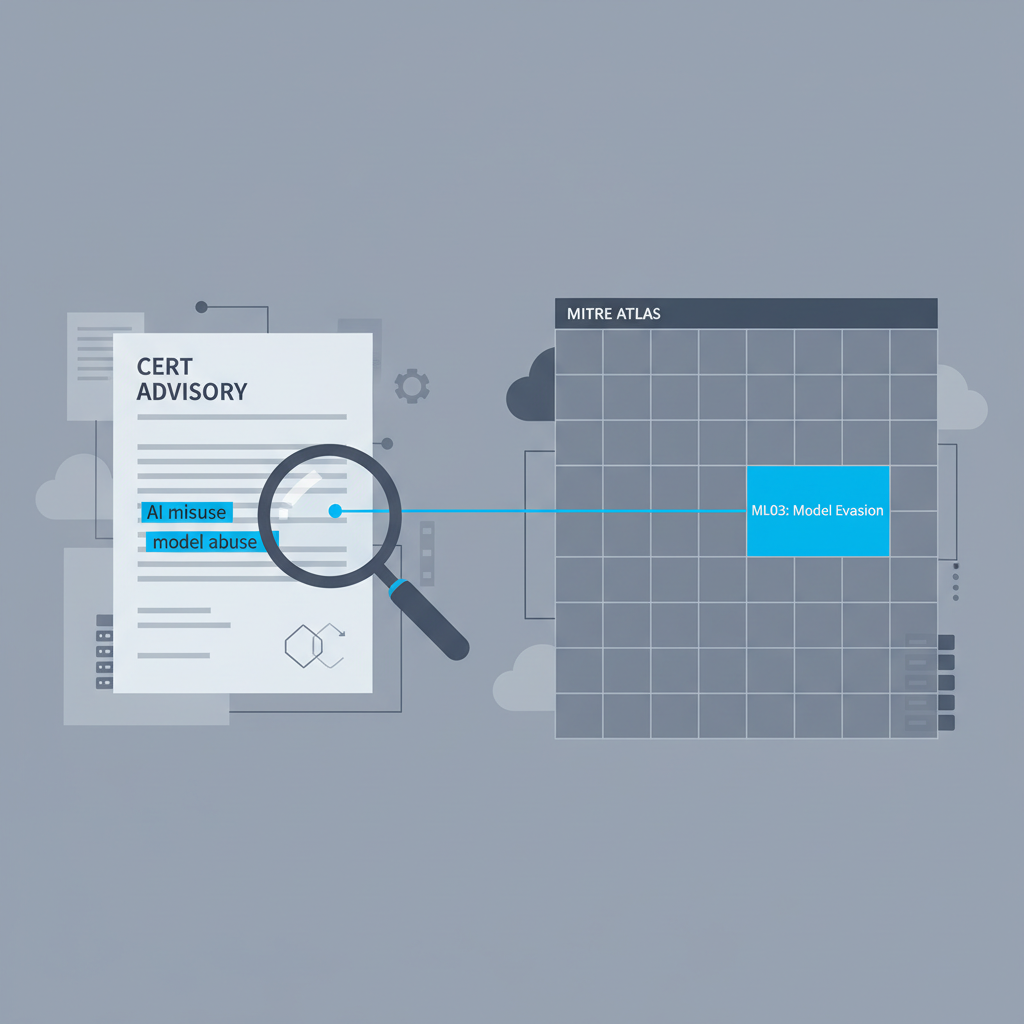
Executive Summary: This article provides a source-grounded, step-by-step workflow for security teams to map AI misuse or model abuse mentions in East Asia CERT advisories to MITRE ATLAS-style controls, focusing on evidence requirements, claims discipline, and actionable mitigations using Nogosee’s tracker as a monitoring layer.
Why It Matters
Security teams operating in global AI and cloud environments need reliable methods to translate regional threat intelligence into actionable risk controls. East Asia CERT advisories from sources like JVN (Japan), KrCERT (Korea), and TWCERT/CC (Taiwan) increasingly include references to AI misuse, model abuse, or generative AI risks, but these signals often lack the specificity needed for direct control mapping. This workflow provides a disciplined, source-grounded approach to evaluate such advisories and map relevant claims to MITRE ATLAS-style controls without overstating risk or succumbing to hype. The process begins with monitoring Nogosee’s East Asia Cyber & AI Risk Tracker as a curated layer for public signals from Taiwan, Japan, and Korea. Teams should start by searching for AI security, model risk, or generative AI themes using exact product names, CVE identifiers, or threat tags like 'ai-security' or 'generative ai'. The tracker’s structured signal database allows filtering by source family, sector, and date to isolate relevant CERT advisories before opening the source-linked record for deeper review.
Once a potential AI misuse signal is identified, the next step is to inspect the original CERT advisory linked in the tracker record. Teams must verify whether the advisory includes named entities (e.g., specific AI models, vendors, or systems), describes observable technical behaviors (e.g., prompt injection, data poisoning, model evasion), and specifies affected sectors or use cases. Advisories that only mention 'AI risk' generically or rely on speculative language should be treated as monitor-only items until further evidence emerges. The tracker’s public boundary disclaimer reminds users that capped exports are samples—full context requires opening the source link. This step ensures claims discipline: only advisories with concrete, reproducible technical details proceed to control mapping.
Technical Signal
After verifying the source advisory, teams should map any validated AI misuse claims to corresponding MITRE ATLAS tactics and techniques, such as ML01: Data Poisoning, ML02: Adversarial Example, or ML03: Model Evasion. The mapping must be directly supported by the advisory’s description—for example, if a TWCERT/CC note describes malicious inputs causing a vision model to misclassify traffic signs, this maps to ML03 with mitigations like input sanitization and runtime monitoring. Teams should avoid inferring techniques not explicitly described in the source. Each mapping should include a brief rationale citing the specific advisory detail that justifies the control selection, preserving traceability and reducing false positives.
Actionable mitigations should only be recommended when the source advisory provides sufficient technical context to justify them. For instance, if a KrCERT advisory details how poisoned training data led to backdoor behavior in a language model, mitigations like data provenance tracking, anomaly detection in training pipelines, and adversarial retraining become relevant. If the advisory lacks such detail—e.g., only warning about 'potential misuse of generative AI'—teams should defer mitigation planning and instead monitor for follow-up disclosures or technical reports. Ownership of the mapping process should be assigned to AI security or model risk specialists within the team, with escalation to cloud security or SOC leads only when the mapped control relates to a system in active use and the advisory confirms exploitability or observed impact.
Operational Impact
Finally, teams should use the mapped ATLAS controls to inform repeatable workflows: updating watchlists, refining detection rules, or prioritizing red team exercises. The Nogosee tracker supports this through capped CSV exports, RSS feeds, and local watchlist functions for ongoing monitoring. Teams are advised to review mapped signals during regular risk syncs, compare them with global threat intelligence, and re-evaluate if new source-linked records emerge. This workflow does not prescribe fixed cadences or rigid thresholds but encourages flexible, evidence-based review. By grounding each step in the source advisory and using Nogosee as a verification layer—not a source of truth—teams can maintain operational clarity, reduce alert fatigue, and ensure that AI risk controls are driven by actual regional signals, not assumptions.
Treat the official source as a monitoring input, not as proof that every feed entry deserves a public article. The practical value is a repeatable triage layer: capture the source title, original URL, visible publication date, affected product or service when available, and the operational surface involved. When those fields are thin or ambiguous, the item should stay in the tracker as monitoring data rather than becoming a standalone post.
Event Type: security
Importance: medium
Affected Sectors
- AI Security
- Cloud Infrastructure
- Cybersecurity
- Government
- Technology
Frequently Asked Questions
What is the first step in mapping East Asia CERT advisories to MITRE ATLAS controls for AI misuse?
Start by searching Nogosee’s tracker for AI security, model abuse, or generative AI risk signals from Taiwan, Japan, or Korea CERTs such as JVN, KrCERT, or TWCERT/CC, then inspect the source-linked record for named entities, technical context, and sector impact before proceeding.
How should teams verify claims of AI misuse in a CERT advisory before mapping to ATLAS controls?
Treat Nogosee as a monitoring layer: open the original CERT advisory, check for specific technical details like model inputs, attack vectors, or data poisoning methods, and confirm whether the advisory provides observable evidence or only speculative claims before accepting it for control mapping.
When should a team escalate a mapped AI misuse signal from an East Asia CERT advisory?
Escalate when the advisory includes verified technical details, confirms affected models or systems in use by your organization, and maps to a high-impact ATLAS tactic such as model evasion or data poisoning with clear mitigations; otherwise, retain for monitoring only.
What mitigations are actionable when mapping AI misuse to MITRE ATLAS controls from East Asia CERT sources?
Actionable mitigations include input validation, model monitoring for drift or anomaly, access controls on training data, and red teaming for adversarial robustness—prioritized only when the source advisory provides specific, reproducible technical context supporting such controls.
How can teams avoid hype when mapping AI misuse in CERT advisories to ATLAS-style controls?
Avoid hype by requiring named entities, sector-specific impact, and technical details in the source advisory; reject vague or speculative claims; use Nogosee’s tracker to compare signals across sources; and base control mappings only on observable, source-grounded evidence, not inferred risk.