Answer Brief
Cloud and SaaS teams should use the JVN vulnerability feed to review Japanese supplier exposure through vendor inventory, patch responsibility, internet exposure, compensating controls, and escalation triggers. This checklist provides actionable steps for ongoing risk monitoring without implying new publication or fixed cadences.
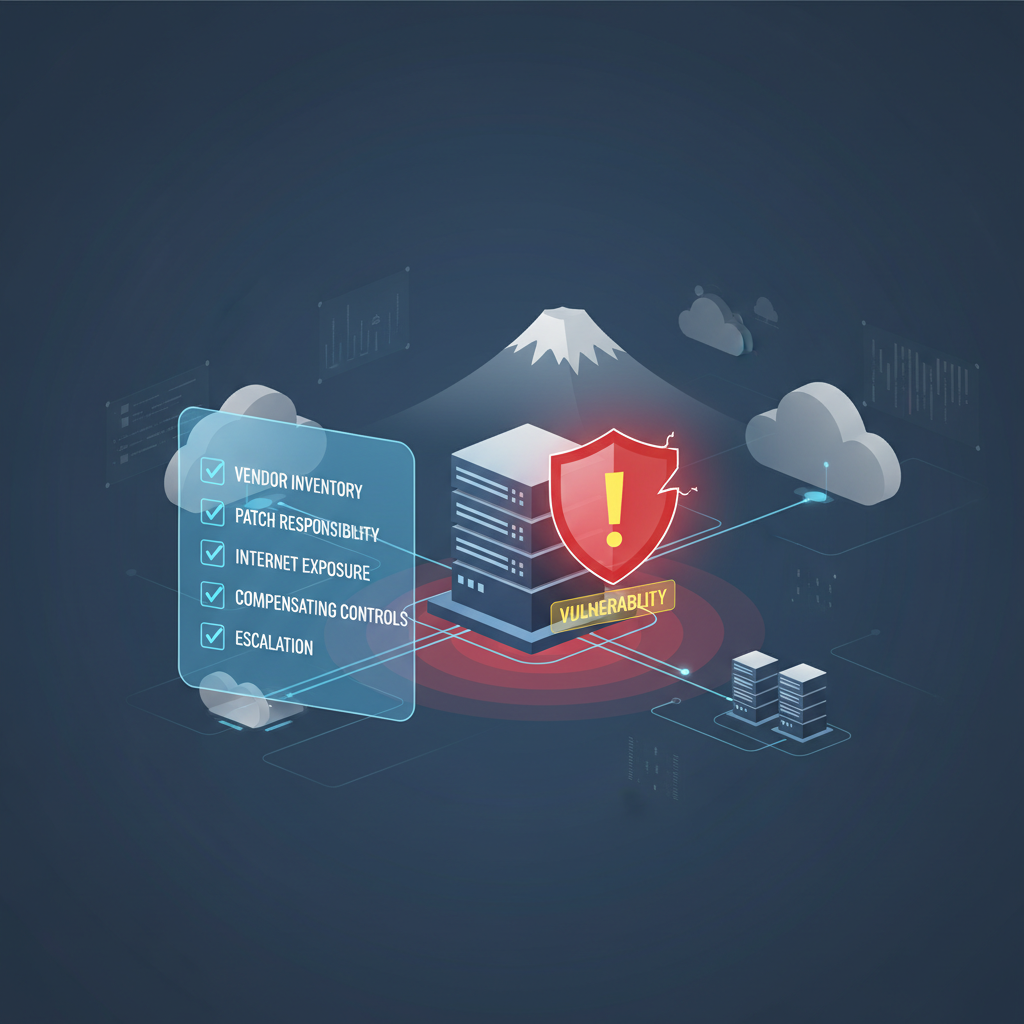
Executive Summary: Cloud and SaaS teams should use the JVN vulnerability feed to review Japanese supplier exposure through vendor inventory, patch responsibility, internet exposure, compensating controls, and escalation triggers. This checklist provides actionable steps for ongoing risk monitoring without implying new publication or fixed cadences.
Why It Matters
Cloud and SaaS teams managing Japanese suppliers should treat the JVN vulnerability feed as a continuous source of exposure intelligence rather than a one-time alert source. The feed provides structured vulnerability notes from Japanese vendors and CISA advisories relevant to ICS and medical systems, which may intersect with cloud-connected operational technology. Teams should begin by extracting recent entries from the JVN RSS or JSON feed and filtering for Japanese-affiliated vendors such as Trend Micro, Canon Marketing Japan, ELECOM, Fujitsu Japan, WPS, Bytello, and others appearing in the feed. Each entry should be reviewed for product names, vulnerability types, and publication dates to determine relevance to cloud-deployed or SaaS-integrated components.
A practical first step is maintaining an up-to-date inventory of Japanese suppliers and their products used in cloud environments, especially those with agents, connectors, or hybrid deployments. For each product in use, teams should check JVN for associated vulnerability identifiers (JVNVU or JVN numbers) and assess whether the flaw impacts internet-exposed services, authentication mechanisms, or data handling paths. Vulnerabilities like insufficient intent validation in Android apps (e.g., RoboForm) or plaintext transmission of sensitive data (e.g., au’sあんしんフィルター) may indicate broader secure coding gaps in supplier ecosystems.
Technical Signal
Patch responsibility must be clarified early: JVN notes often include vendor statements but do not specify remediation ownership in third-party contexts. Teams should consult supplier contracts, support agreements, and vulnerability disclosure policies to determine who applies patches—vendor, system integrator, or internal team. When responsibility is ambiguous, this should be flagged as a risk gap requiring contractual or process clarification.
Internet exposure is a critical trigger for escalation. If a vulnerable Japanese supplier product is deployed in a public-facing cloud workload, accessible via API, or used in end-user-facing SaaS modules, teams should prioritize verification of exploitability and compensating controls. For example, stack-based buffer overflows in GUARDIANWALL MailSuite or access control flaws in WPS Office named pipes may pose risk if these services are internet-accessible or integrated into cloud authentication flows.
Operational Impact
Compensating controls such as WAF rules, runtime application self-protection (RASP), network isolation, or strict API gateways should be validated against the specific exploit conditions described in JVN notes. Teams should not assume generic protections are sufficient; instead, they must map vulnerability details (e.g., attack vector, authentication requirements, privilege level) to existing defenses. If no effective controls exist, or if the vulnerability is wormable or pre-authentication, escalation to senior security and procurement leads is warranted.
Escalation thresholds should be flexible but risk-based: prioritize flaws with public exploit code, active exploitation in the wild, or impact on confidentiality/integrity of cloud-stored data. Avoid rigid rules like fixed CVSS thresholds or patch windows; instead, use qualitative judgment based on exploit context, data sensitivity, and availability of mitigations. Teams should document decisions in a review log to support auditability and continuous improvement.
What To Watch
Finally, the review process should be treated as recurring rather than periodic. As new JVN entries appear—such as the multiple advisories from mid-to-late May 2026 covering Trend Micro, ISC BIND, Movable Type, and various ELECOM products—teams should incrementally update their assessments. There is no implied publication date or refresh cycle; the process should be driven by feed updates and internal change management cycles. Source links to individual JVN entries should be preserved for verification and sharing with stakeholders.
Treat JVN as a monitoring input, not as proof that every feed entry deserves a public article. The practical value is a repeatable triage layer: capture the source title, original URL, visible publication date, affected product or service when available, and the operational surface involved. When those fields are thin or ambiguous, the item should stay in the tracker as monitoring data rather than becoming a standalone post.
For readers watching Japan, the escalation question is whether the notice touches a real local, national, regional, sector, or operating dependency. Supplier exposure, cloud identity, telecom, financial services, government systems, semiconductor or manufacturing links, public-sector technology, managed service providers, and internet-facing infrastructure are strong signals even before global media frames them as cross-border events.
A healthy workflow separates three outcomes. Routine items become searchable tracker records. Items with clear patch urgency, exploitation language, named affected technology, or cross-border supplier relevance become article candidates. Items that are old, duplicated, underspecified, or mostly vendor boilerplate should remain monitor-only even if they contain familiar cybersecurity keywords.
Event Type: security
Importance: medium
Affected Sectors
- cloud-security
- saas
- technology
Frequently Asked Questions
How should cloud and SaaS teams start reviewing Japanese supplier cyber risk using JVN?
Begin by exporting the latest JVN vulnerability feed and filtering for entries related to Japanese vendors or products used in your supply chain. Focus on recent advisories from the last 30–60 days to identify active exposures.
What are the key steps in assessing patch responsibility for Japanese suppliers?
Determine whether the vendor, integrator, or your team owns patch application by reviewing contracts, support SLAs, and vulnerability notes that specify remediation ownership. Document gaps where responsibility is unclear.
When should teams escalate a Japanese supplier vulnerability finding?
Escalate when a vulnerability is publicly exploitable, affects internet-facing systems, lacks vendor patches, or has no compensating controls in place—especially if tied to critical cloud or SaaS integrations.
How can compensating controls be validated for Japanese supplier risks?
Review network segmentation, WAF rules, access logs, and endpoint protections to confirm whether exploitable paths are blocked. Use JVN details to map exploit conditions to existing defenses.
What should teams do after completing a JVN-based supplier risk review?
Update vendor risk registers, share findings with procurement and security owners, schedule rechecks when new JVN entries appear, and track remediation progress through ticketing systems.